Layers of Barriers: How STRJ is Fighting for Reproductive Care in the RGV
Story by Melissa Cortes Santiago
Edited by Abigail Vela
- August 15, 2025
Since the Supreme Court decided to end the constitutional right to abortion in 2022 with the Dobbs decision, reproductive justice has faded from the news cycle. But across the country and here in the Rio Grande Valley (RGV), the damage and repercussions are still very much present.
Reproductive healthcare infrastructure has always been fragile in the RGV. Clinic closures, immigration checkpoints, lack of Title X providers, and legal threats have piled onto each other, making it difficult for community members to access care. Whether it’s contraception, abortion care, or prenatal support, the crumbling infrastructure has created a maze of barriers with no clear way through.
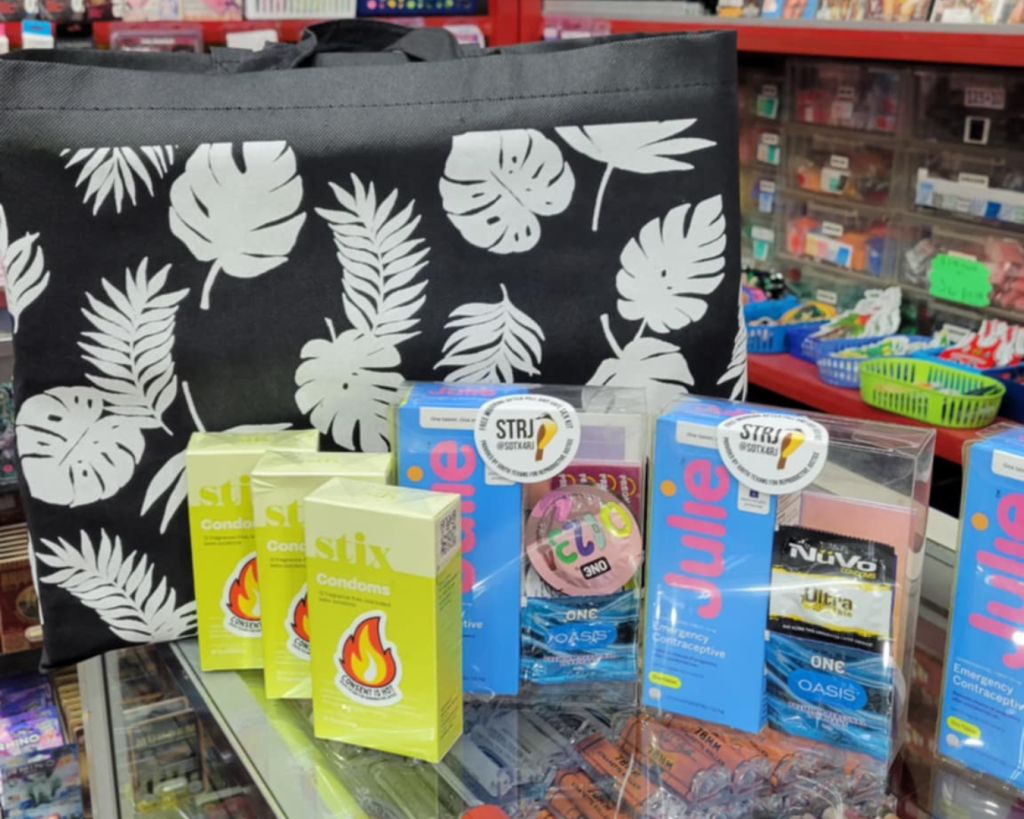
Nonprofits and grassroots organizations across the RGV have stepped in to fill the gap. South Texans for Reproductive Justice (STRJ) is a volunteer-run organization that distributes free Plan B, safe sex kits, and educational material to 32 counties across South Texas. The organization provides tools and information people can use to navigate the increasingly hostile landscape here in South Texas.
Why the RGV is a Healthcare Desert
Even before the fall of Roe v Wade, reproductive care in the Valley was scarce, and now the gap is even more drastic. Out of the 32 counties that STRJ serves, only four have access to a Title X clinic, a primary source of affordable reproductive and sexual healthcare. That means that for a lot of people, routine services like birth control and STI testing can be out of reach.
“Accessing basic care is incredibly difficult, because we exist in this reproductive health care desert,” said STRJ co-founder and co-leader Denni Arjona (they/them).
The barriers our community faces extend far beyond the lack of affordable clinics. The RGV is in a heavily militarized zone. There are 19 permanent Border Patrol Checkpoints across South Texas, creating unique obstacles for our community. Driving north to seek care inevitably means passing through one of these checkpoints, which is intimidating even for those with legal status. For undocumented folks and mixed-status families, attempting to go through these checkpoints is incredibly risky.
“There aren’t a lot of options when it comes to traveling to access abortion care,” Arjona said. “There are layers of barriers.”
With abortion bans in place in Texas, many reproductive health needs now go unmet. STRJ cannot fill every gap, but it has stepped in to provide what Arjona calls “layers of protection.” One of the most visible efforts is a free emergency contraception mailing program.
“Having access to emergency contraception is not the solution for everything,” they said. “But it’s one layer of protection people can have.”
But doing this kind of work can come with challenges. STRJ faces constant hurdles in securing funding for more than just supplies.
“As a volunteer-run organization, there’s so much red tape with accessing grants,” Arjona said. “We’ve been successful in funding supplies. But sustaining ourselves to continue this work has been a consistent challenge, probably our biggest one.”
Why Information About Abortion Matters, More Than Ever
For many in the Valley, traveling out of state for an abortion is not an option. “The reality is not everybody can travel,” Arjona said. “Many cannot, because of their documentation status, lack of funding, disability, or even fear of roving border patrols.”
In those cases, information can make a difference when it comes to safety. Self-managed abortions, often through medication, are not new, but have increased since abortion bans went into effect across the country. Knowing how to perform them safely, what symptoms to expect, and when to seek emergency care is essential.
“There are shield states where providers can prescribe abortion pills through mail without facing legal repercussions,” Arjona explained. “So, they can ship to states like Texas. People need to know that, but also what symptoms to look out for, even if they access care out of state and return home.”
Sharing this kind of information is not without risk. Texas lawmakers and anti-abortion groups are working to restrict what information can be shared about abortions. STRJ has already felt pressure, but Arjona says the organization remains committed.
“We will always make sure our community has the information they need, regardless of the risk,” they said.
Uplifting the RGV Through Artivism

To prepare for potential censorship, STRJ recently launched a campaign called Make Love Not War. The initiative compiles information on self-managed abortion, legal rights, and reproductive health. The goal is to turn all of the information into a zine and distribute it by hand. If digital platforms are forced to remove abortion-related content, the zine ensures that community members will still have access to life-saving knowledge.
For Arjona, the work at its core is about love for the RGV and its people. “I love our community,” they said. “We gotta take care of each other. There’s something special about the Valley… it is amazing to witness when you see our community come together.”
Although the news cycle may have moved on from the reproductive healthcare crisis our communities face, the obstacles are still present. Through creative resistance, grassroots efforts, and a deep commitment to our community, STRJ and many other reproductive justice groups in the Valley ensure that reproductive healthcare, in all its forms, is still accessible to our communities.