Last July, President Trump signed into law H.R.1, also known as the “One Big Beautiful Bill Act” (OBBBA). The bill, which Congress passed through a budgetary process called “reconciliation,” included cuts to Medicaid, the Affordable Care Act (ACA), food nutrition programs and more. It also included a staggering $170.7 billion in additional funding for immigration and border enforcement, $45 billion of which will be used to expand and boost detention center capacity in several states, including Texas.
A breakdown of ICE’s plan
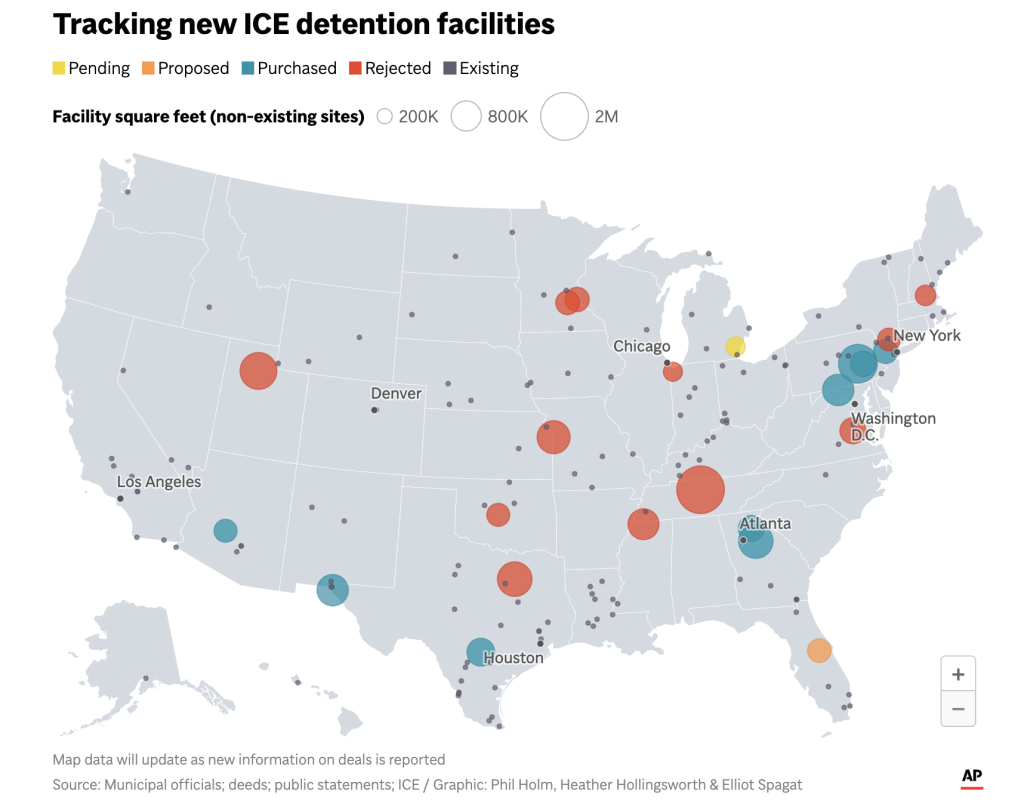
U.S. Immigration and Customs Enforcement (ICE) released details about its plan last month. It includes:
- 16 “processing sites”
- 8 “large scale” detention centers
- 10 “turnkey” facilities
The project is expected to cost $38.3 billion, which will be funded through the OBBBA.
According to the American Immigration Council, ICE already spent $700 million on 9 warehouses it plans to refurbish for this new project. One of them is in Socorro, Texas, near the Rio Grande. It’s one of 3 facilities that are expected to be “large-scale,” with 7,500 to 10,000 planned beds. Other purchased facilities, like the one in San Antonio, will be smaller processing sites. Those are planned to hold 1,000 to 1,500 people each.
Here in the Rio Grande Valley, there is one prospective site.
A warehouse in McAllen is being eyed by the Department of Homeland Security (DHS) as a processing center, with a planned 500 beds, according to an ICE warehouse purchase tracker. The warehouse, which is located on South International Pkwy, is owned by Centennial Park LLC.
On March 11, we reached out to DHS about the possible purchase and the impact it might have on our community. We have not heard back.

What’s behind the expansion?
The plans to boost detention center capacity come as immigration related arrests continue nationwide.
According to Transactional Records Access Clearinghouse (TRAC) reports, since the start of this year, at least 39,000 people have been booked into detention centers by ICE. Texas holds the highest number of immigration detainees, with nearly 18,000 people in ICE custody.
TRAC data also shows that ICE relied on Texas to house the most people during the 2026 fiscal year.
ICE is clearly looking for more space – but they’re doing it quietly.
The Associated Press (AP) recently reported that the Trump administration is using military contracts to build the detention centers. Those contracts allow DHS to “move quickly without following the usual processes and safeguards.”
On top of that, some communities on ICE’s list are reporting that ICE isn’t telling them anything until after purchases have been made, leaving local officials scrambling to find out what’s happening, according to AP.
These expansions have not only raised questions but also concerns and fears among these communities. Will there be a financial hit? Will it put a strain on local resources, such as city utilities?
ICE has not stated clear impacts or any other details about the detention center expansion project. However, AP reports ICE said these facilities will be exempt from property taxes.
Backlash and backing out of deals
Not all of the planned expansions have followed through.
In Texas, plans to buy a warehouse in Dallas have been canceled after reported public push back. That facility would have been “large scale,” and likely the second biggest in our state, with nearly 9,000 beds.
AP is reporting that in some cases, warehouse owners are also refusing to sell.
With McAllen on the list of potential sites, the possibility for a new detention center in the Valley is up in the air.
ICE plans to have facilities refurbished and up and running by the end of this fiscal year.