“A Taste of the Last Poet in the Woods” Exhibit: An Ekphrastic Journey Through Art and Nature
Story by Kristin Montez
Edited by Abigail Vela
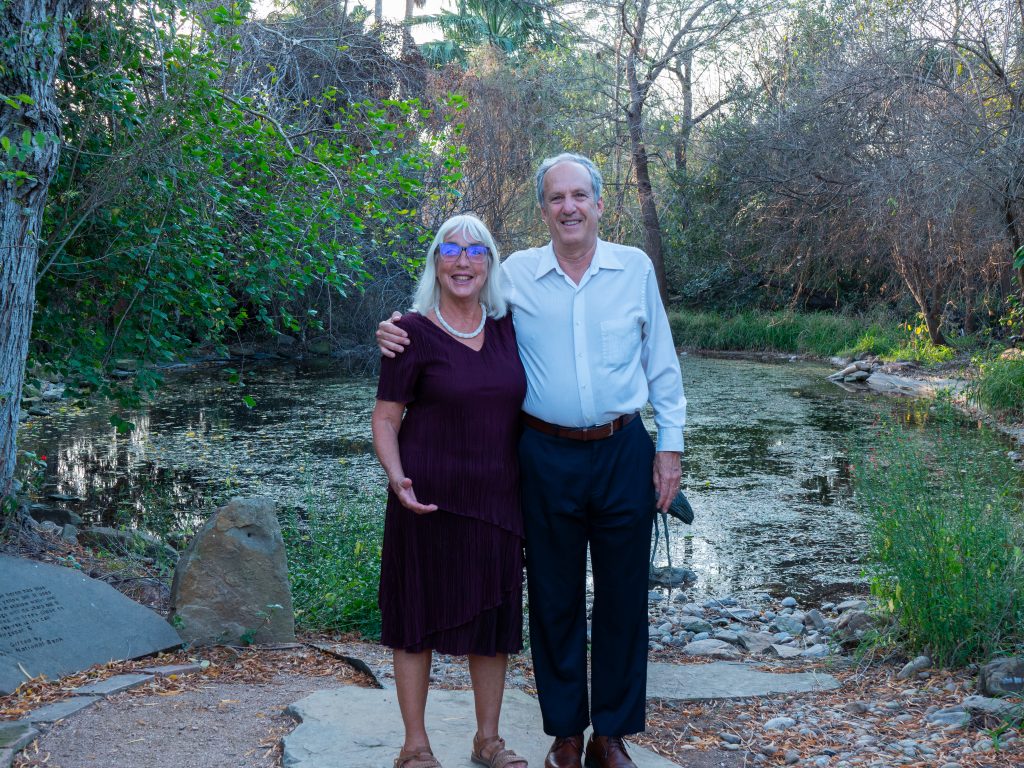
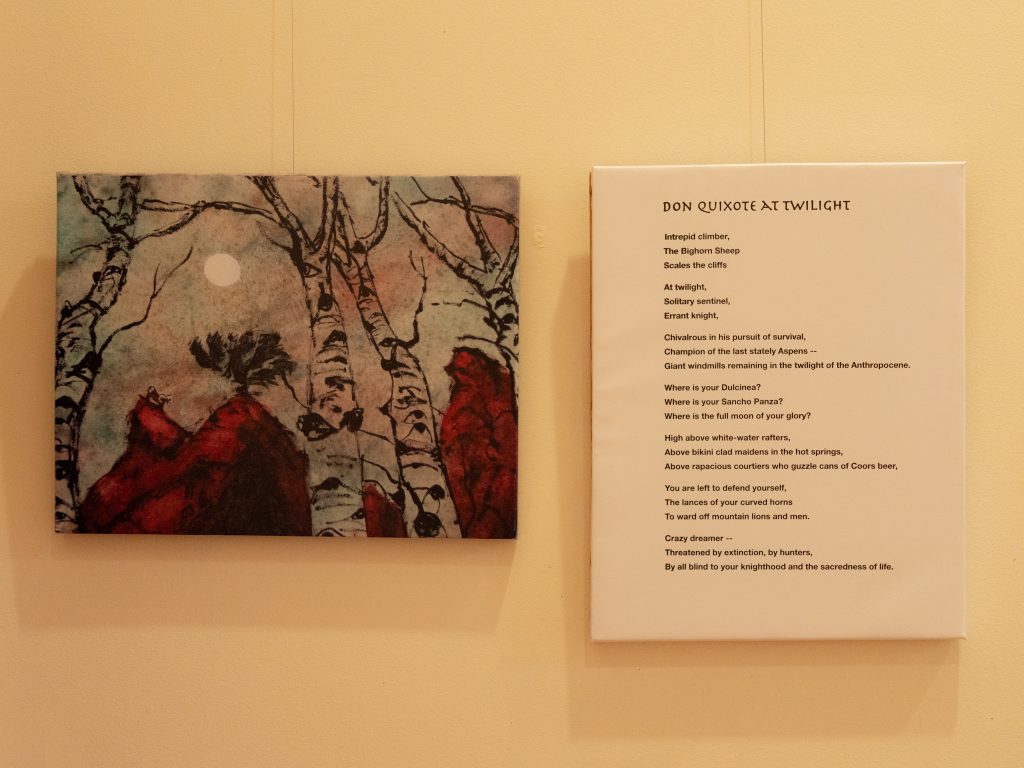
I was guided through the 90-year-old Spanish Revival mansion, home to Tamaulipan Thornforests, nestled in the commercial center of South Mcallen. February 6 was the opening of “A Taste of The Last Poet in the Woods: Eco-Tapestry of Art and Poetry” at Quinta Mazatlan. It’s just “a taste” of artists Reefka and Steven P. Schneider’s ekphrastic exhibit, which is a curation of seven watercolor paintings and their accompanying ekphrastic poems–a poetry form where the poem is inspired by a work of art— and hosted inside the sanctuary’s Discovery Center.
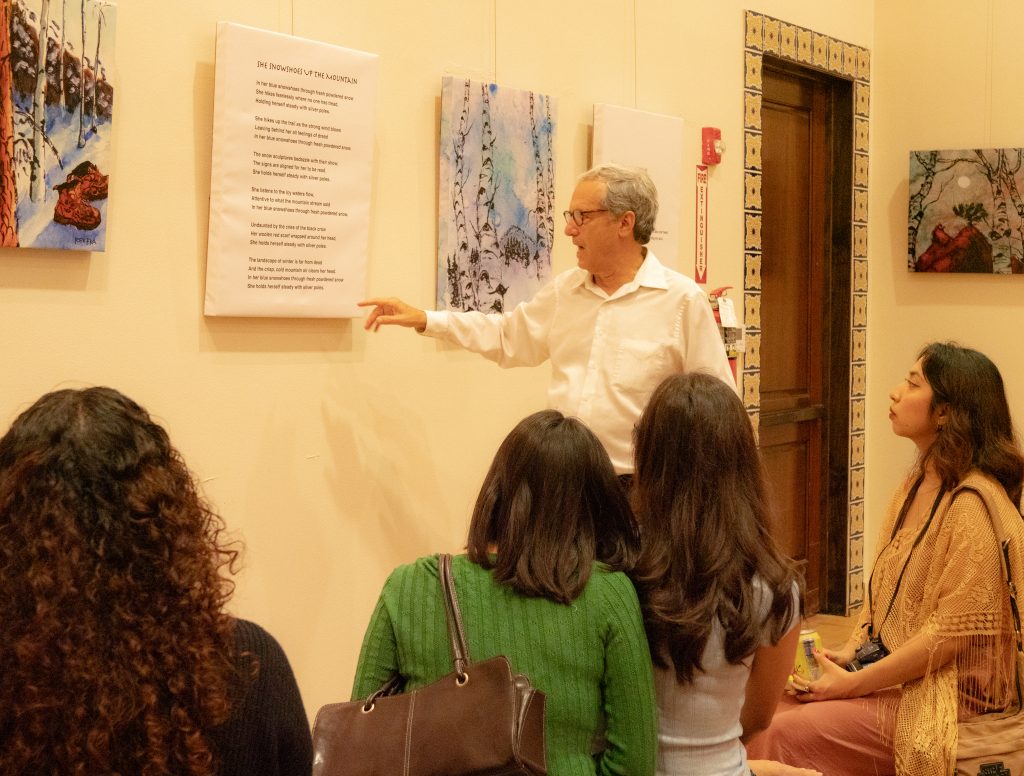
“That’s pretty much how this whole ekphrastic exhibit works–where the poem is trying to capture not only the content of the painting but the mood of the painting, the tone of it,” explains Steven Schneider as he shows me a watercolor piece painted by his wife Reefka depicting a woman’s pair of snowshoes nestled in a snowy rampart aptly titled “She Snowshoes Up The Mountain.” Schneider says the paintings were painted in and around Taos, New Mexico.
A “Synergistic” Collaboration
The Schneiders have been marrying the expression of art and poetry for twenty-one years. “We have been collaborating as far back as 2004 when we did a poetry-art exhibit called “About Love,”” says Scheider.
Between 2004 and 2016, he and his wife collaborated on other ekphrastic books, such as “Borderlines: Drawing Border Lives,” published by Wings Press in 2010, and their second major exhibit and book, “The Magic of Mariachi”/”La Magia del Mariachi,” an English and Spanish collection of twenty-four ekphrastic poems and paintings that capture the magic of contemporary mariachi musicians, published in 2016. Schneider says, “Our creative process is synergistic, and we share work with each other often.”
“Last Poet in the Woods” is an artistic response to the concept of biophilia, defined by Edward O. Wilson as “the urge to affiliate with other forms of life.” This exhibit serves as a “lasting tribute to nature’s wonders.” Another source of inspiration was Richard Louv’s “Last Child in the Woods,” which explores the consequences of the Nature-Deficit Disorder. “Last Poet in The Woods” is a collection of paintings and poems that merge art and literature to reignite one’s connection to the natural world. The paintings and poems were divided into seasonal categories—Summer, Fall, Winter, and Spring—with each piece evoking the unique experience of its respective season.
An Interactive and Reflective Activity About Nature
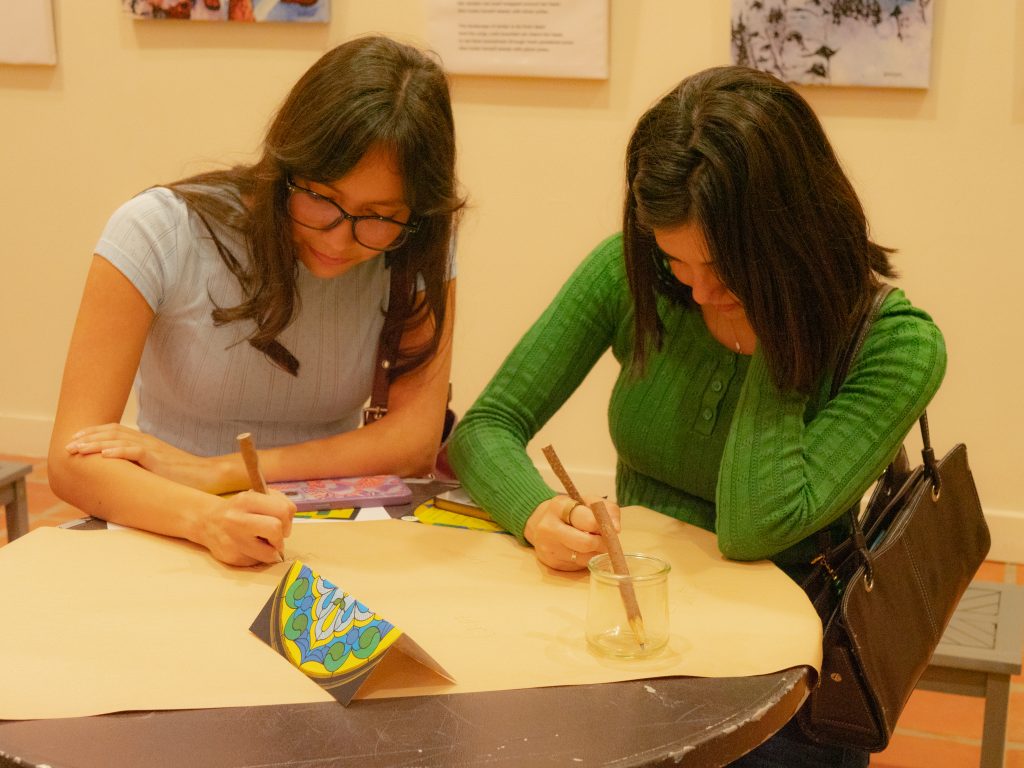
Exhibit attendees were invited to gather in groups in the middle of the gallery, where parchment-lined tables with tree-bark pencils and thought-provoking prompt cards awaited. Steven Schneider began an activity where he asked everyone to recall and write answers to the prompts on their table.
The prompt at my table asked, “How does nature inspire you?” Schneider encouraged us to utilize memories and senses when thinking about our answers–a method commonly used in ekphrasis writing.
I’m a screenwriter, so my writing is visually influenced by the aesthetics I experience in nature. Until this moment, I’ve never taken a moment to think critically about how rooted that connection between my artistic expression and my experience with nature actually is. Schneider walked throughout the room, allowing each participant to share their prompt and answers out loud with everyone.
The Connection between Environmental Awareness and Artistic Expression
When asked what was the significance of choosing a place like Quinta Mazatlan to house this environmentally conscious exhibit, the Schneiders explained how the themes explored in their exhibit undoubtedly align with Quinta Mazatlan’s initiative of connecting and educating people about their ecological environment.
Schneider, who teaches in the Creative Writing department at UTRGV and has offered several classes that focus on the connection between the environment and writing, explains, “I also think that the RGV needs greater environmental awareness, which our exhibit promotes through poetry and art, and which I also teach in my MFA eco-writing class. We hope viewers will be inspired by the poetry and art to reflect on their own creative relationship to the natural world. If the exhibit also inspires viewers to engage with nature through their own writing and art, that would be wonderful.”