Ya le diste una (“You hit it once”),
Ya le diste dos (“You hit it twice”),
Ya le diste tres (“You hit it three times”),
¡Y tu tiempo se acabó! (“And your time is up!”)
This chant represents the second half of the song that’s sung when kids hit piñatas at celebrations in Latino tradition. Piñatas are typically suspended and actively guided by participants, swaying through the air as they are raised and moved, creating a shifting, elusive target. While a blindfolded person swings, the lyrics urge children to strike the dancing object in mid-air just right, which they cannot see.
In the Rio Grande Valley, piñatas are an unassuming part of the region’s culture. Shops that sell piñatas range from the backs of family trucks to long-established businesses along U.S. Business 83, or what is now commonly referred to as “Old 83.” Valley-born-and-raised readers might recall childhood parties at Peter Piper Pizza, at home, or in a park, where piñatas filled with candy were suspended with string for children to hit, break open, and collect falling sweets in a frenzy. Josué Ramírez celebrates and reinterprets piñatas in his solo exhibition, “Piñatabstract,” on view at the International Museum of Art & Science (IMAS) in McAllen.
Ramírez encourages viewers to consider the history of piñatas in his exhibition. The objects are widely believed to originate in China in the thirteenth Century. The Dachunniu (“Hitting of the Spring Ox”) is an ancient Chinese agricultural ritual tied to the Lunar New Year. In this tradition, hollow oxen sculptures are filled with seeds, which participants symbolically strike to release them. This practice encourages a bountiful harvest, and each participant takes some seeds home. Some believe that the piñata as we know it now was brought from this Chinese tradition to Europe by Marco Polo after his travels along the Silk Road, though this connection remains speculative.
However, Dr. Juan Manuel Galván, professor of history at Lone Star College-Kingwood, argues that it is more likely that Italian pignatte (meaning “fragile pots”), which are tied to Catholic tradition, played a role in contemporary variants of piñatas in Latin American society. The scholar elaborates on how Augustinian missionaries purposefully adapted the pre-existing European Lent custom to become a highly visual, hands-on teaching tool for the conversion of Indigenous children, who were easier to convert than adults. Traditional Mexican piñatas contain a body, which represents Satan, and seven arms, which embody the seven deadly sins: pride, greed, lust, envy, gluttony, wrath, and sloth. Today, these objects are made from materials such as newspaper, cardboard, tape, and a variety of craft papers, including tissue paper, known as “papel China.”
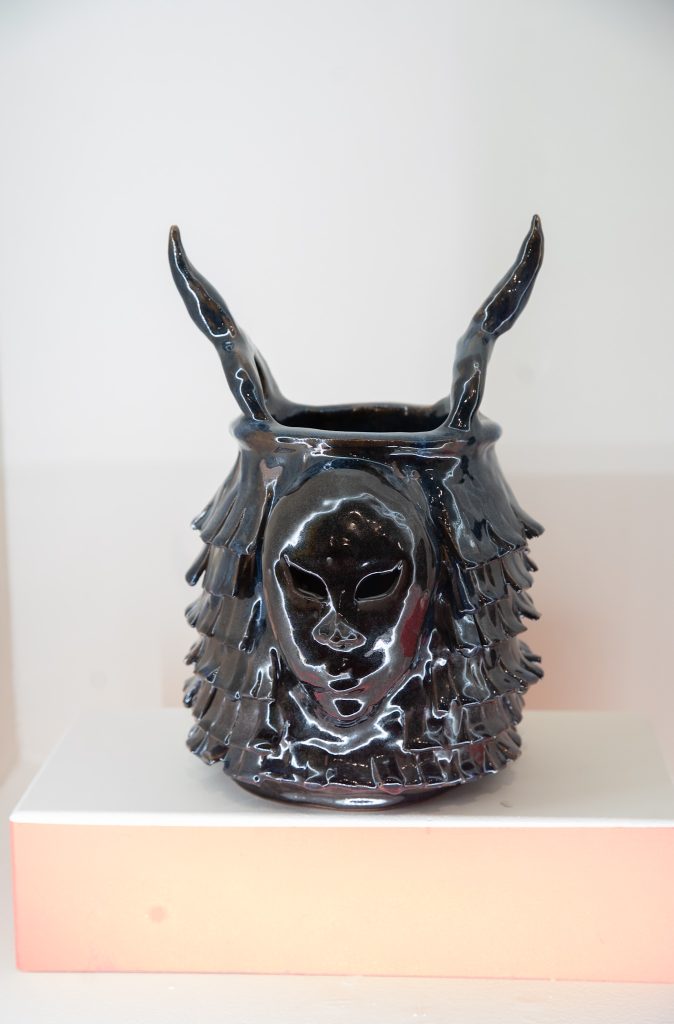
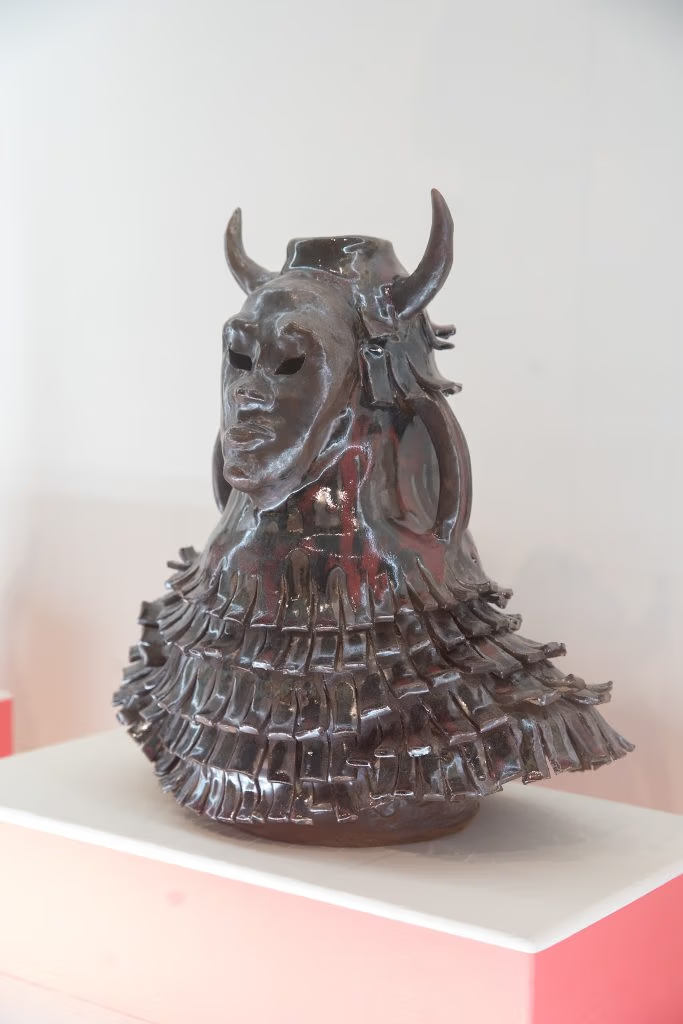
Ramírez consolidates the complicated and conflicting history of the piñata in his “Pignatta Deity Vessel” series, including “Pignatta Deity Vessel – Black” and “Pignatta Deity Vessel – Red.” The vessels evoke a ritual presence through their hybrid forms. Masks protrude from the surface of each cup, accompanied by horn-like extensions that distort the traditional vessel structures. The face masks are notably spotless, with hollow eyes that imbue them with a sense of ambiguity. Furthermore, the ceramic medium recalls the piñata’s early European origins as a clay container. In an email correspondence with me, Ramiréz states, “I wanted to reference the clay pot, the horns and the fringe to create a vessel that holds all the ritualistic energy of the piñata practice through the ages.”
Rather than illustrating a fixed history, Ramírez constructs a speculative visual lineage of the piñata, one shaped as much by the unknown as by reference. “Pignatta Deity Vessel – Black” presents only the head of an indeterminate figure, while “Pignatta Deity Vessel – Red” extends into a dress-like form, with the mask positioned at the center of the torso, replacing the chest.
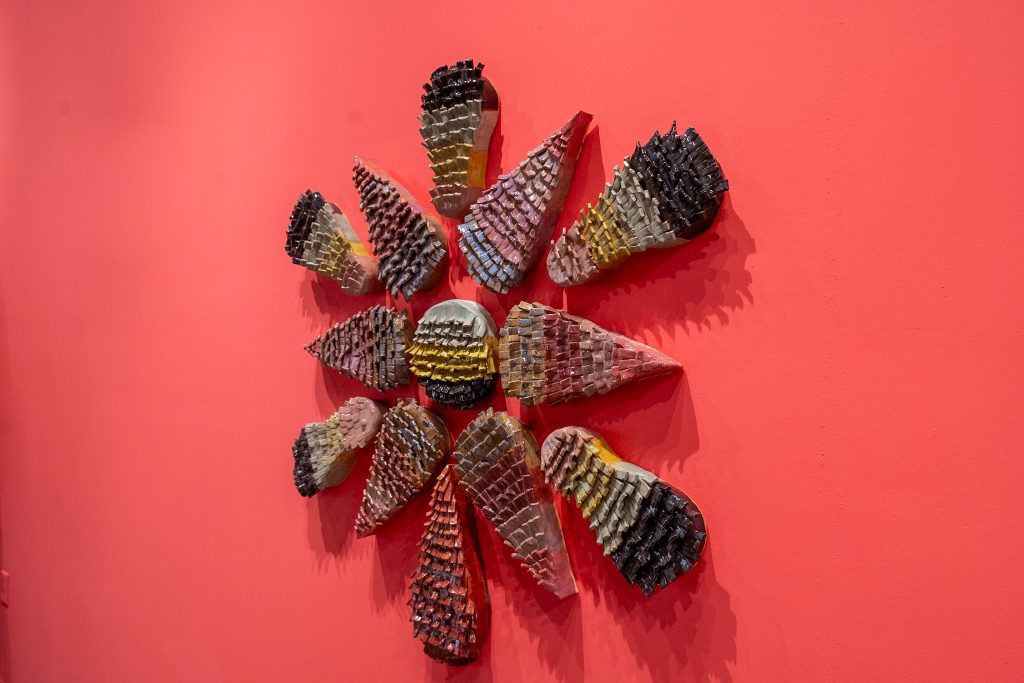
Ramírez references the symbolic attributes of traditional Mexican piñatas in “Fringe Form.” The entire artwork is ceramic, once again alluding to the original ceramic form of the piñata when it was a pignatta. “Fringe Form” depicts the object’s central body surrounded by multiple stone-like arms. The artist creates ceramic indentations across the various parts that reference the ruffled texture of tissue paper used to create piñatas today. This plays on our visual expectations, as piñatas are commonly made of paper and cardboard rather than ceramic, prompting viewers to reconsider the object’s material history.
Now, piñatas take on a wide range of forms, depicting figures such as cartoon characters, movie stars, everyday objects, and cultural heroines and villains. Piñatas also touch on wider communal humor. Yolanda Saldivar-shaped piñatas, struck by a young girl dressed as Selena Quintanilla, allude to the destructive history embedded in these cultural objects. “Piñatabstract” was largely inspired by another controversial figure in the U.S. Latino diaspora: President Donald Trump. In an interview with Trucha’s Editorial Director Abigail Vela, Ramírez states that “Donald Trump piñatas were a big source of my initial interest [in piñatas] … I was upset at seeing a figure like that being portrayed in this medium… I started learning more about what the piñata is as a cultural icon.” In this way, Ramírez situates the piñata within a broader cultural framework of projection, tension, and release.
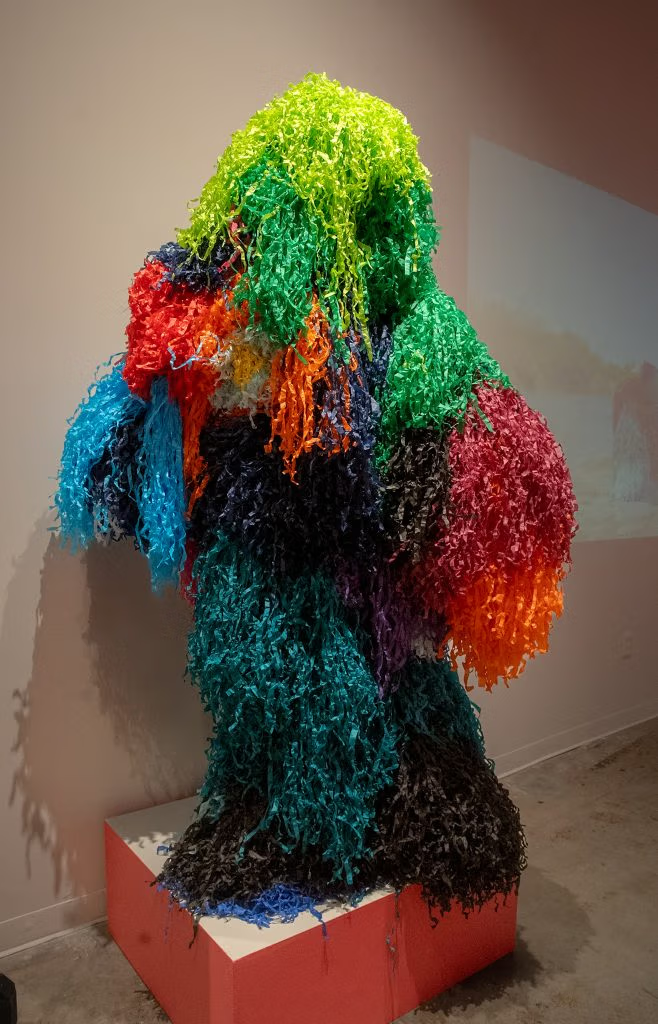
Ramírez also subverts what we know to be true about these effigies. For example, with “Piñata Person: Spill,” the artist anthropomorphizes the piñata and repositions it as a figure of power. Typically the target of one’s wrath, the piñata becomes an agent of reversal, its presence contingent on the body that inhabits it. One of several human-sized piñata costumes in the exhibition, the work can be worn by visitors, and at the opening reception on February 13, 2026, Ramírez and a group of collaborators activated these suits through performance.
Even when still, as it’s presented on a podium, the suited piñata maintains a sense of power through its scale. It resembles a colorful ghillie suit; however, rather than concealing the body as a traditional ghillie suit would, its vibrant surface demands visibility.
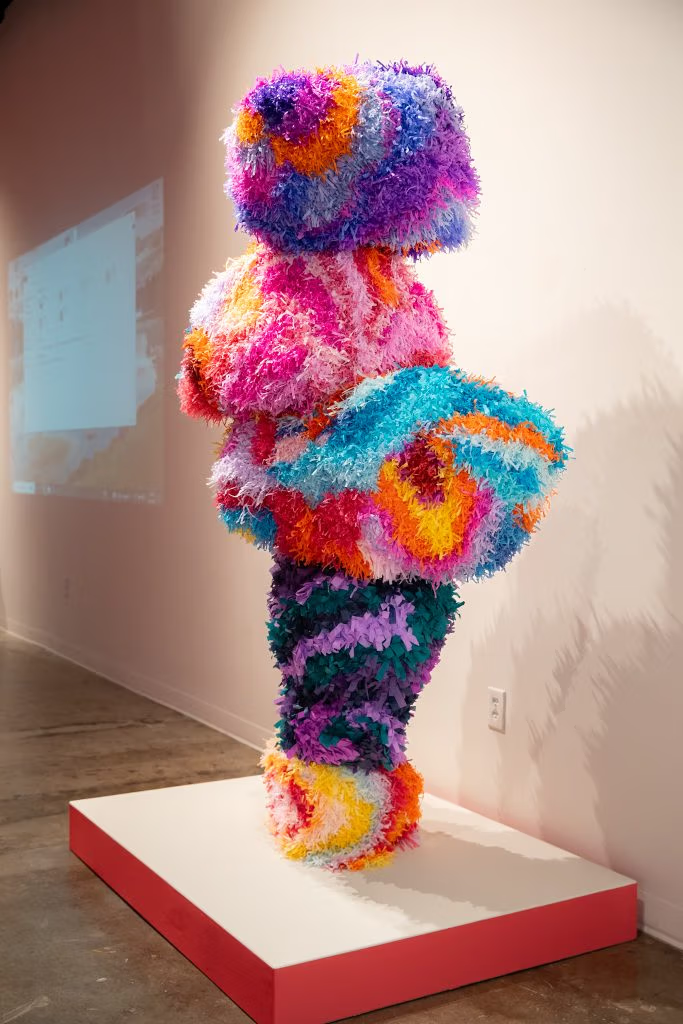
In “Dancing Formation,” Ramírez assembles five distinct piñata bodies, each marked by its own color scheme, and stacks them vertically to create a single, upright figure. This vertical accumulation lends the work a totemic presence. The fusion of distinct piñata bodies unifies the artwork while preserving a sense of individuality in each form, suggesting an accumulation of gestures, histories, and interpretations that constitute the varied cultural narratives surrounding piñatas.
With “Piñatabstract,” Ramírez showcases the piñata as far more than a celebratory object. Across ceramic vessels, performative costumes, and composite forms, the artist reveals the piñata as a cultural artifact where varied histories, rituals, and communal expressions converge. “Piñatabstract” ultimately positions piñatas as icons of ongoing interpretation, where meaning is never fixed but continually produced through ritual, projection, and play.
“Piñatabstract” is on display at the International Museum of Art and Science in McAllen through July 26, 2026.