On March 10th, without warning, President Trump announced in a post on Truth Social that the “FIRST new U.S. Oil Refinery in 50 YEARS in Brownsville, Texas” will be built. He described it as a “HISTORIC $300 BILLION DOLLAR DEAL – THE BIGGEST IN U.S. HISTORY” and “A MASSIVE WIN” for Valley residents.
Part of the project’s funding will come from investments by the Indian conglomerate Reliance Industries, led by Asia’s richest man, Mukesh Ambani.
Trump also claimed the refinery will be “THE CLEANEST REFINERY IN THE WORLD” without offering specifics on what that entails.
Groundbreaking is expected in April 2026.
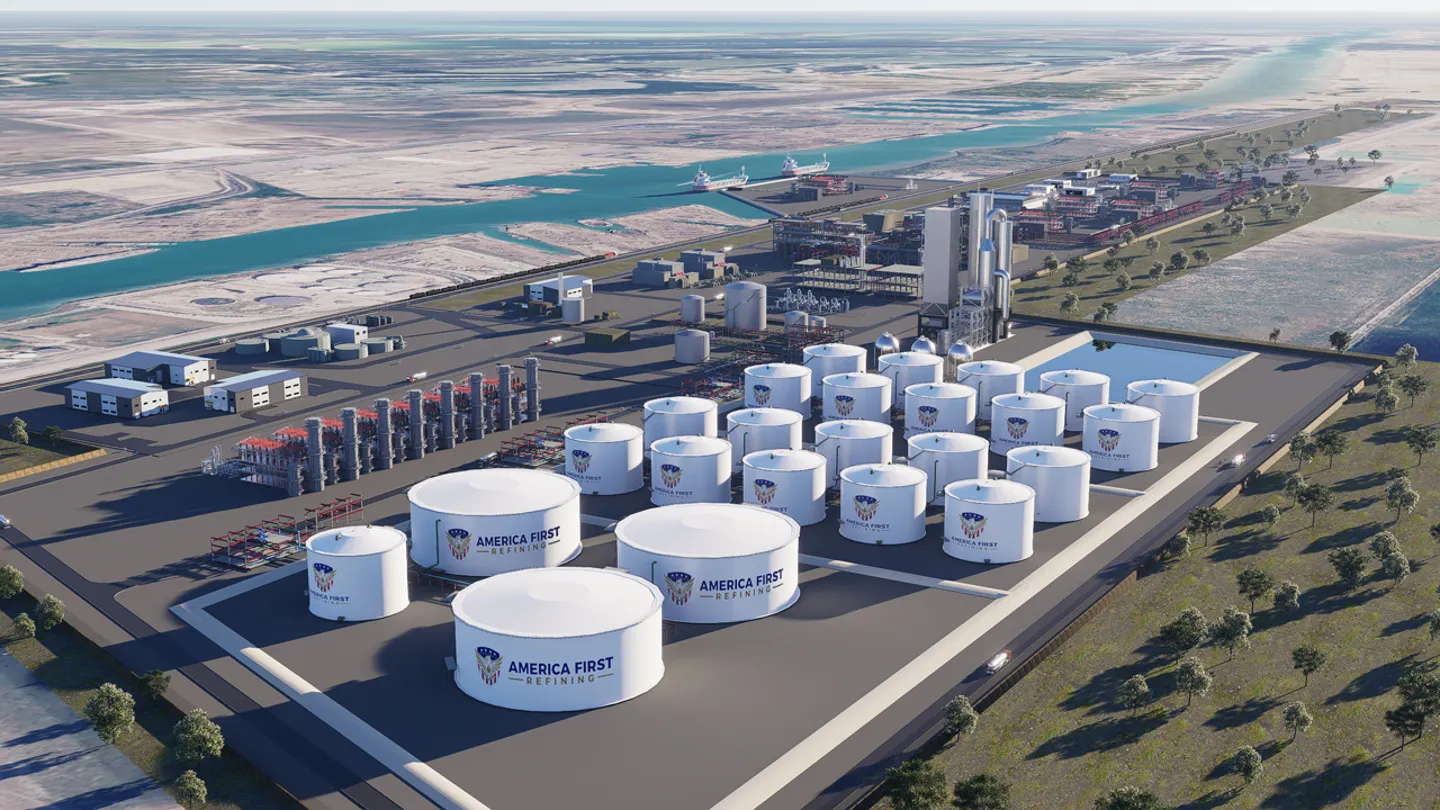
Photo credit: America First Refining
It is ironic that a project of this scale – one that must have been in the works for quite some time – has moved forward with so little input from the thousands of residents who will ultimately bear its consequences.
So far, there has been minimal community outreach and no widely circulated, comprehensive information to address the legitimate concerns of Brownsville residents.
Most of the organized pushback has come not from officials but from local groups such as the South Texas Environmental Justice Network, which has opposed the project since it was first proposed more than seven years ago.
Investors may argue that the refinery offers a path to much-needed economic development in a low-income region. Yet refinery construction typically produces only about 100 temporary jobs and far fewer permanent positions – roughly 500 on average. If that is the trade-off, then local residents are right to question the terms of the deal.
Brownsville residents should also consider that it’s been half a century since a new refinery was built in the United States due to the environmental concerns they pose and because few communities are willing to accept them. The risk is simply not worth the reward.
A look north offers a clear example. In Louisiana’s “Cancer Alley” – an 85-mile stretch of the Mississippi River between New Orleans and Baton Rouge – decades of heavy industry and oil refining have left entire communities exposed to pollution. Parts of this region are now described as “sacrifice zones”: areas where land, soil and water have been so contaminated that long-term habitation is in question.
These zones are disproportionately located in low-income and historically marginalized communities. In Cancer Alley, many Black communities that predate the arrival of the refineries in the mid-20th century have borne the brunt of the consequences.
Sacrifice zones are not accidents. These zones are the result of deliberate decisions. They are places deemed expendable, sparsely resourced, or unable to resist the change. They are further enabled by local governments that yield to outside investors promising economic growth in exchange for undervalued land.
If the proposed oil refinery moves forward, the consequences will be immediate and visible.
Communities in Cancer Alley have been linked to elevated rates of diseases including leukemia and cancers of the lungs, sinuses, and throat – as well as higher incidences of asthma, pneumonia, birth defects, infertility and miscarriage.
At the same time, the Rio Grande Valley’s water system, already strained by droughts and declining river levels, would face additional pressure from a water–intensive refinery.
In Corpus Christi, where industrial demand has already stretched water supplies thin, residents now face chronic rationing and mounting financial strain with no clear long-term solution.
Simply put, oil refineries guarantee both profit for investors and unmitigated pollution that doesn’t respect borders, barriers or walls.

Photo Credit: Brenda Bazan
No doubt, there are many valley residents who see this as an opportunity to transform the region into the next hot spot for new restaurants and shopping centers, but the move could also prove a nail in the coffin of the way of life the Rio Grande Valley has enjoyed for generations.
What’s At Stake
It’s easy to forget that in Brownsville’s backyard lies the longest barrier island in the world. In the same vein, Valley residents take for granted the benefits of living next to such a unique ecosystem.
Brownsville sits at the crossroads of major migratory flight paths, hosting a wealth of bird species not found anywhere else on the mainland United States, which directly supports a burgeoning birding industry that attracts visitors from around the world.
Residents of the Valley have the luxury of spending a calm weekend fishing in the waters off South Padre or in the Laguna Madre, where they can fillet and cook their catch at day’s end, or simply take in the Laguna’s beauty at sunset.
These defining features of the South Texas coast are invaluable assets. They are not owned by a single billionaire, nor can they be leased at the discretion of politicians; they are our shared inheritance – shared spaces for all to enjoy today and preserve for future generations.
Once lost, this inheritance cannot be regained.

Photo Credits: Brenda Bazan
Brownsville residents and RGV locals are facing a reality in which they can no longer safely fish or eat their fresh catch in their own local waters, where poor air quality is no longer confined to a few bad days a year, but becomes a constant presence driven by heavy industry at their doorstep, growing hungrier for resources by the day and where diseases such as cancer and birth defects begin to take hold in local communities, while water is deemed unsafe to drink.
Evidence of this future is already scattered along the Gulf Coast.
It is now up to local residents to make their voices heard, not just to demand answers, but to force a long-overdue evaluation over what is being gained, what is being lost, and who ultimately gets to decide the Valley’s future.