
She Put Everything on that Bagel, Even the RGV
Review by Santana Peralez
Edited by Abigail Vela
SPOILERS AHEAD
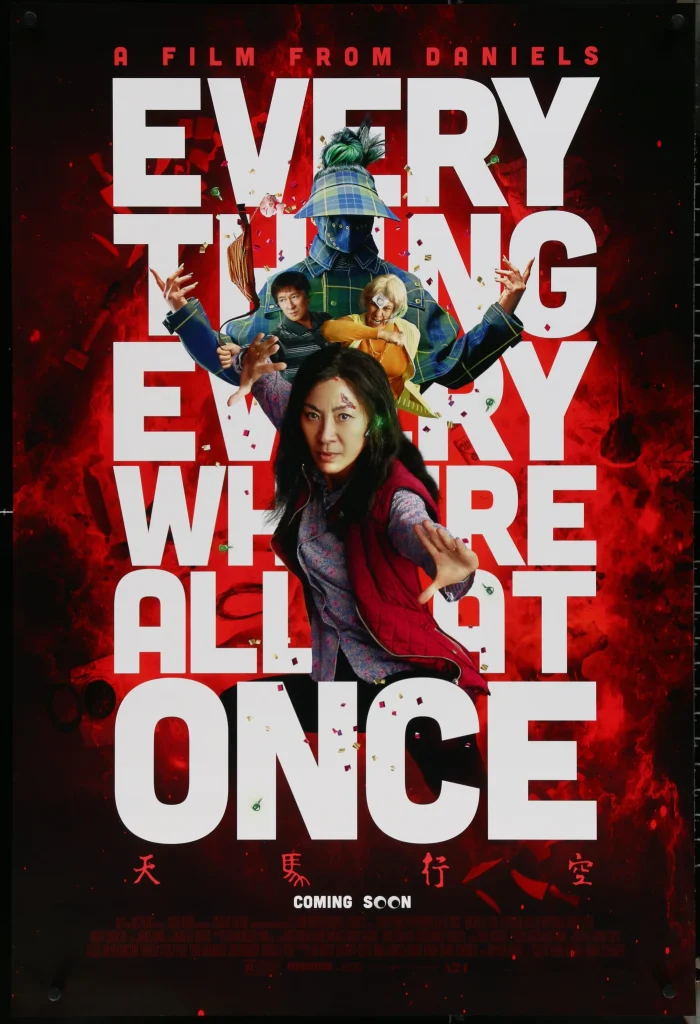
2022’s “Everything Everywhere All At Once” (EEAAO) is often celebrated for its dazzlingly dizzying visuals, darkly chaotic humor, and multiversal madness. Still, at its core, when you take away the glitter, the lights, fight scenes, and the hot dog fingers, EEAAO is a story about a first-generation American daughter and an immigrant mother trying to understand each other. It’s a story that many of us here in the RGV have seen, for many of us it it’s our story too. Watching the film through the lens of the Rio Grande Valley’s immigrant communities, it feels less like science fiction and more like a mirror showing us a reflection we already know by heart.
Evelyn’s (played by Michelle Yeoh) complicated relationship with her daughter, Joy (played by Stephanie Hsu), is not only the catalyst for this film but the heart of it. On the one hand, Evelyn, who gave up her entire life in China, eloping with Waymond (Ke Huy Quan) to the United States, and doing everything she could to build a life for her family, survived every hardship by clinging tightly to tradition. On the other hand, you have Joy, trying to carve her own life outside the boundaries of her parents’ traditions while also desperately trying to find understanding with her mother. It’s a scene that plays out in immigrant communities across the world, especially here in the Valley, where so many of us exist as the bridge between our parents’ ideas and the American values we grow up around.
The first real insight we see into Evelyn and Joy’s relationship is how Evelyn handles Joy bringing her girlfriend to meet her Gong Gong (Cantonese for Grandfather). Joy’s queerness becomes more than a plot point; growing into a wound that festers because Evelyn doesn’t know how to fully accept it, not out of hatred, but out of deep fear, fear of judgment from her traditional family members, fear of being seen as a failure, and a fear of losing the people she loves. As a queer daughter myself I understand this fear very well.
In the RGV, Catholicism and conservative values often run deep, queer acceptance within immigrant families can be slow, painful, and layered with contradictions. Joy’s desperate need for her mother’s validation mirrors the longing many queer children in the Valley feel, the wish to be seen, to be loved without conditions. For our parents to embrace us for who we are and not who they want us to be. Evelyn’s journey toward accepting her daughter’s queerness is very much not linear; it is messy, complicated, and full of backslides, just like the real conversations happening here, in cocinas late at night over pan dulce y cafecito or at family gatherings when your parents have had a bit to much to drink.
EEAAO also dives headfirst into another hard topic in immigrant communities, mental health struggles. Evelyn and Waymond both carry invisible burdens that they can barely name. The pressure to survive, to make good on the sacrifices of immigration, leaves little room to acknowledge mental health needs. We see this bleed into Joy across the multiverse, in the depression and nihilism that causes her to become the omnicidal Jobu Topaki, and in the depression that the main Joy shows signs of. In the Valley, access to affordable mental health care is scarce, and stigma runs high; many people carry their generational trauma quietly, wearing smiles while breaking inside, similarly to Evelyn and Joy. EEAAO doesn’t offer easy fixes. It shows the pain of being everything to everyone, a feeling all too familiar to first and second-generation immigrants trying to straddle two worlds.
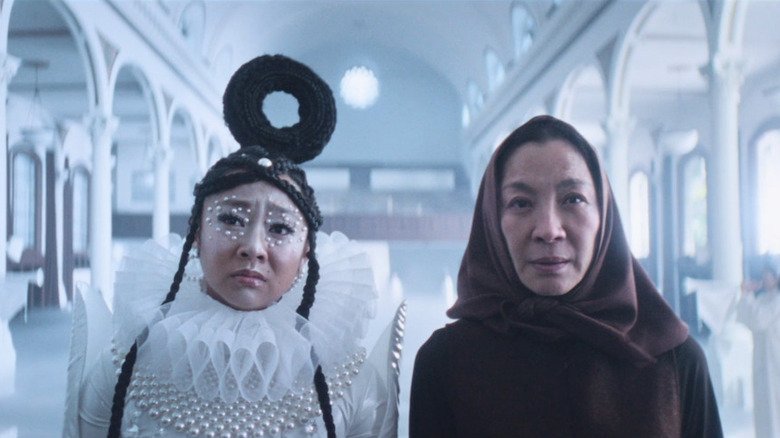
Ultimately, EEAAO is about acceptance: of our messy selves, our imperfect families, and the uncertainty of life. For immigrant communities, especially those in the Rio Grande Valley, it’s a call to soften, to give ourselves and each other grace in a world that rarely does. EEAAO reminds us that love, though imperfect, can still be transformative if we let it be.
Rating: 5 Nopales

Have a movie in mind you’d like to review? Submit to Cine Trucha here!