
**Trigger Warning for the movie: heavy gore**
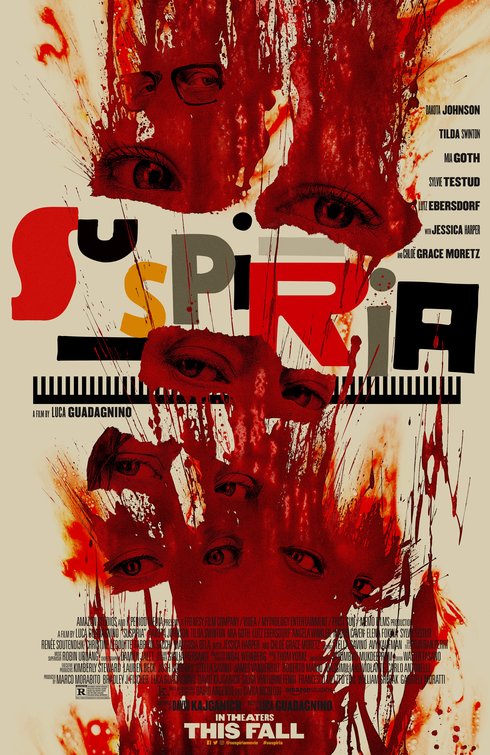
Directed by Luca Guadagnino (“Challengers”) and written by David Kajganich (“Bones and All”), this remake of a bright, then-modern 1977 Argento film gets flipped into a more silent, but sexual piece. Through the movie, we follow Susie Bannion and other young dancers at the Markos Dance Company in 1977 Germany as a sinister plot orchestrated by the staff of witches unfolds.
While the original evoked fairy tales through disregard for continuity and highlights bright but morbid shots, the 2018 version is a grim snapshot of the past that makes you sit with the characters and what they are going through. No matter how jubilant the scene, you are always left with a morbid anxiety that something sinister could happen in an instant.
This movie deals a lot with themes of motherhood, repression, and femininity, as well as systems corrupted from within. To that end, the movie depicts characters with varying reactions to unspoken atrocities.
Why This Movie is Worth a Watch
The movie received divisive criticism, upsetting many fans of the original. However, I find its changes were intentional and a beneficial retouch. Guadagnino knew that the original was affected by misogynistic views of the time and its director. This is why the characters (all but 2 minor roles played by women) have more agency, knowledge, and common sense. The acting is incredible across the board. From Dakota Johnson in arguably her best role, to Tilda Swinton pulling the weight of playing multiple characters. Thome Yorke (Radiohead) debuts as a composer and shows he knows how to build tension as the film uses sound masterfully to convey dread, suspense, and the ambience of life during a politically dangerous time. The costumes, sets, and lighting all do their part to sell the grim nature, and reserve the bright color for when magic is being evoked. The practical effects also do their job, making your body feel absolutely uncomfortable when the gore happens. This movie is not without faults; however, it is a very visually dim movie, which is sometimes, but not always, useful for the scene.
Why I’m Talking About This Movie
**Spoilers ahead, to avoid them, skip to Paranoia**
This movie takes place during the German Autumn, a tense couple of months in 1977 Germany marked by an anti-imperialist group called the Red Army Faction, which kidnapped and murdered a former nazi officer, then hijacked a plane in an unsuccessful attempt to get imprisoned members released. This context is sprinkled throughout the movie, which sets the world, time, and tone that our characters live in. Each character represents a type of person during an atrocity. The young women we follow are the victims at varying stages of awareness of said atrocity, and the coven are the perpetrators who hide behind more public enemies at the time.
On the topic of corrupted systems, Patricia is someone smart enough to figure out most of the coven’s plan, but is not believed. Patricia knew an atrocity was happening and was trying to get away, but was painted as an extremist, which the coven took advantage of when she went missing. Olga was keen on manipulating the coven, but let herself be known as a threat to dangerous people. Sara was kind and curious enough to investigate and search for her friends, but did not know or accept that she was dealing with witchcraft. The last of the main dancers is Susie, whose morality is left to interpretation by the end of the film.
While introduced and portrayed as truly feminist caretakers, the coven is still willing to sacrifice young women to meet their goals in a fashion that is arguably just as cruel. It’s important to note that, while the witches are the movie’s villains, they do not represent the systems that harm us transparently. Rather, they are the people, politics, and systems that have a mission to nurture and protect, but still harm you.
However, the character that stuck with me was Dr. Josef Klemperer, whose arc revolves around being a witness to it. It is revealed to us that leading up to holocaust, Josef convinced his wife not to flee, which led to them getting separated when they tried to escape too late. At least part of his motivation is a regret in not listening to her when she voiced her fear of the growing nazi threat. Within the film, he rationalizes Patricia’s horror as a coping mechanism and Sara’s as a cult. He is the witness because, as he says, “I’ve done nothing.”

Paranoia
Overall, this movie touches several themes, interwoven into a dark retelling of a classic. I rewatched this movie by chance, and for the first time, felt a chill when I was reminded of Klemperer’s story. He now stands as a reminder that being inactive during an atrocity is being a witness to it.
We’re seeing things get more dangerous across the country, and whether it’s helping out politically or just caring for your local community, it is better than being a witness. Consider helping out the RGV chapter of the DSA if you’re interested in the former, or a local farm if the latter suits you more.