
With the Primary elections approaching on March 3rd, it’s easy to forget what that actually means for you and me.
Some people might confuse these elections with the November midterms, but it’s important to know the difference.
“One of the things that we try to emphasize during primary elections is that these are two separate elections, and each party [Republican and Democrat] is nominating who they are going to put on the ballot in November,” says Remi Garza, the Cameron County Election Administrator.
Mr. Garza is responsible for ensuring that people who vote are properly registered and that every single ballot cast, irrespective of party, is counted.
The primaries are internal elections within the main parties, with the only two options being the Democratic and Republican ballots. There are no independent ballots that are available to be filled out.
“Some independents come to the polls and are not sure they want to affiliate with one party over the other… we have to remind them that these are party elections,” points out Mr. Garza.
The same goes for the propositions at the end of the ballot. These act as a sort of temperature check within each party, in order to see which policies are most supported by constituents.
The proposed policies are not actually being voted on.
One Week Into Early Voting
There is a saying, “Don’t count your chickens before they’ve hatched,” that accurately describes the situation Texas Democrats find themselves in, one week into early voting for the upcoming March 3rd Primaries.
In the span of a single week, Texas voters, and especially Democrats, have come out in droves to vote in local elections that will tee up many candidates for the main showdown between Democrats and Republicans in the November midterms.
So far, Democrats have outvoted Republicans on a scale seldom seen in Texas politics, outnumbering their conservative counterparts by 100,000 votes by the end of the first week of early voting.
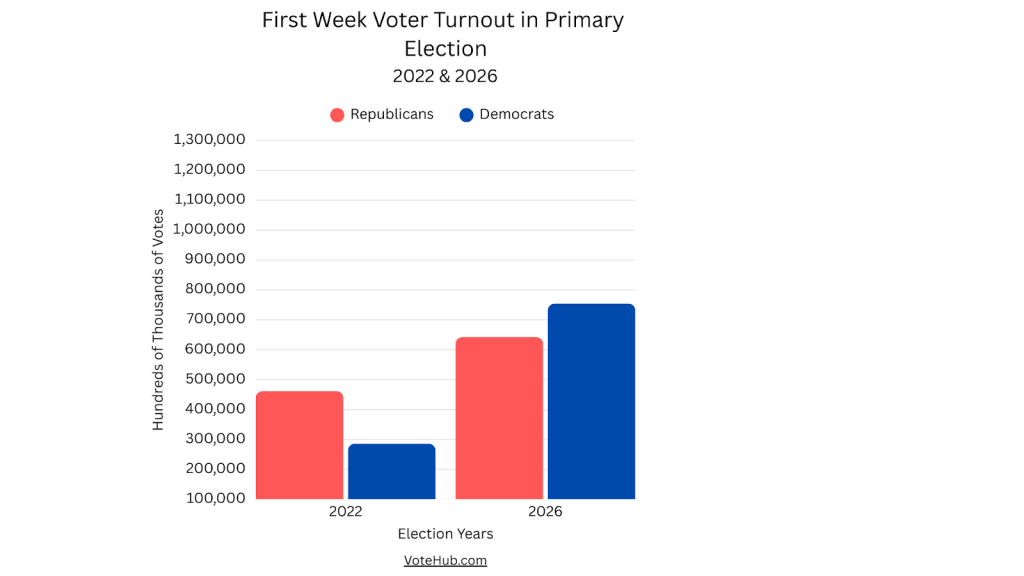
Although the two parties are not directly competing in any elections, the large disparity between Democrats and Republicans in the first week of early voting may be a sign that there is a left-leaning shift that will be significant enough to flip a few districts in the upcoming midterm elections.
Any predictions about the outcome of this year’s elections are made even more complicated by the controversial mid-decade redrawing of Texas districts, which took effect in December of 2025.
Back to the RGV
In the Rio Grande Valley (RGV), Democrats have cast around 42,028 ballots across all 4 counties, while Republicans have cast 9,845 ballots by Monday, February 23rd.
Compared with the 2022 primaries during Joe Biden’s presidency, Democrats cast 26,955 votes during the same period, and Republicans cast 7,864.
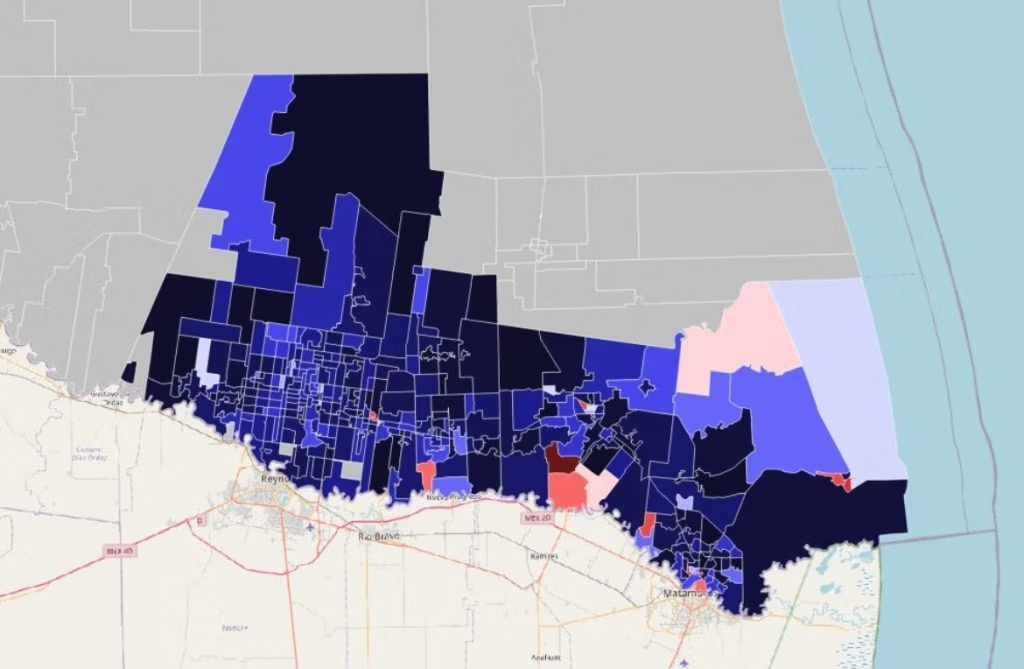
“Compared to 2022, there is an increase in voter turnout,” notes Hilda Salinas, the Elections Administrator in Hidalgo County.
“It’s who and what’s on the ballot that drives the vote… People are engaged and becoming informed, calling our office and asking questions. They are making a point to head to the polls and vote,” says Salinas, when asked about the increase in voter turnout.
In this primary, there are many contentious races that are being watched closely by RGV residents.
In Congressional District 34, which includes Cameron County, Incumbent Vicente Gonzalez is attempting to hold onto his seat against his opponent, Etienne Rosas, despite Gonzalez’s recent controversies surrounding his support of a bill that funded ICE.
In Congressional District 41, which includes Hidalgo County, Tejano singer Bobby Pulido is vying for control of the nomination against fellow democrat Dr. Ada Cuellar.
Zooming out to the state level, Republican Texas State Senator John Cornyn is running for reelection for his fifth term in office. He has been a Senator for the State of Texas since 2002.
Jasmine Crockett and James Talarico are in an especially tight race for the Democratic nomination, slated to take on the Republican nominee for State Senator later this year.
Governor Greg Abbott faces an uncertain path as Texans decide whether to grant him a third term this election season. Among Democrats, a leading primary contender is Brownsville native Gina Hinojosa, who is seeking her party’s nomination.
Early voting runs from February 17th to 27th, leading up to election day on March 3rd. With results only a few days away, how Texans will ultimately vote remains uncertain.