How Michel Flores Tavizón Utilizes Multi-Disciplinary Art as Border Resistance
Story by Nina Alegre
Edited by Abigail Vela
- August 14, 2025
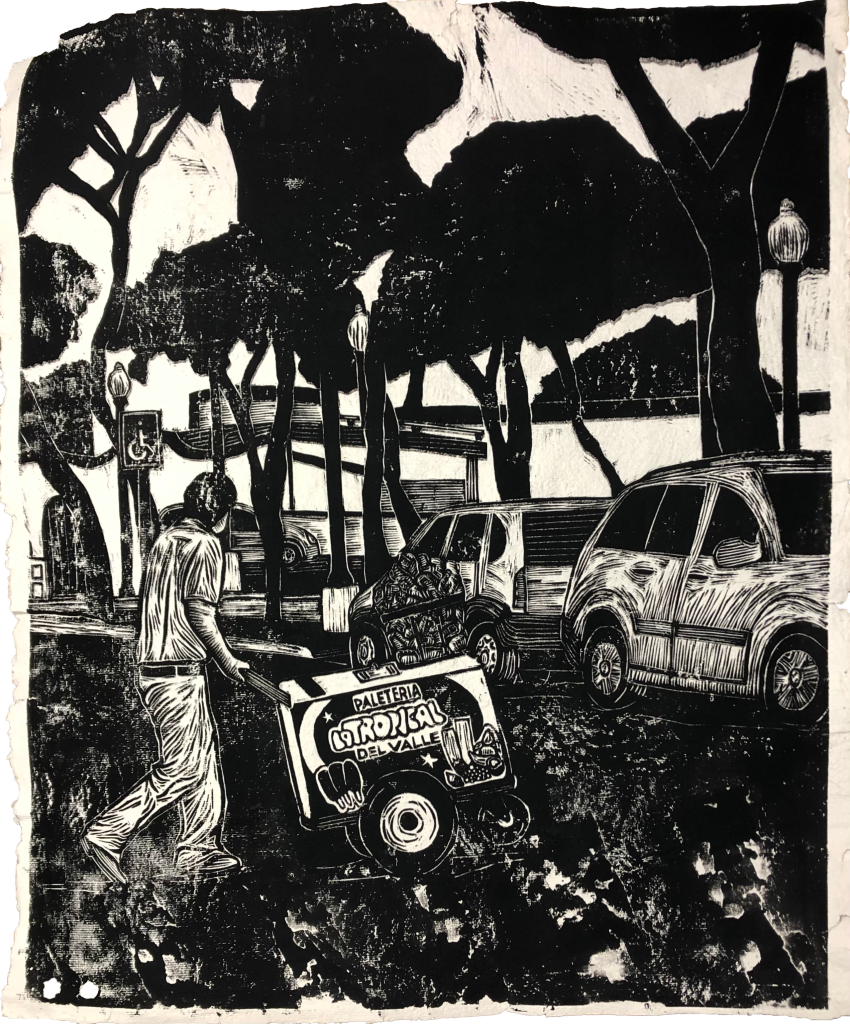
For as long as we can recall, art has been used as a tool for social and political change. Outspoken artists within their respective mediums have continually defied and resisted attacks from their governments, fighting for and raising awareness of equality for all human beings, regardless of where they are from.
From artists, artworks, to protest music, there will always be ways in which creative expression meets the need for resistance. In the past, Trucha has hosted various screenprinting workshops that bring people together for a common cause. Artists of all kinds and mediums have utilized art and screenprinting as a tool to unite, resist, and speak out against social issues.
The bottom line is that art is a form of resistance, and it always will be; creating art brings people together, helping bridge the gap between isolation and community.
One artist, active in the Rio Grande Valley (RGV), who was born and raised in Matamoros, Tamaulipas, and whose art concepts focus on her relationship with the border, is Michel Flores Tavizón (she/her/ella), a multi-disciplinary artist who began studying in the United States in 2016 when she first got her student visa.

An Artist’s Experience: Border and Immigration Activism
As an artist, Flores Tavizón began with printmaking. It was during her time at the University of Texas Rio Grande Valley (UTRGV) for graduate school that she began to branch out into other mediums such as photography, ceramics, and textile work, taking a more multi-disciplinary approach to her creative process. Concept-wise, Flores Tavizón focuses more on her relationship with the border.
Flores Tavizón’s relationship with the border is in itself complex and unique, as she is a voice integrated in the RGV, through her artwork as well as her work with a program she created called Resistencia Fronteriza.
Flores Tavizón talked about the intersection between her art and politics: “2016 is when Trump became president; that’s when I started paying attention to my surroundings. Also, my transition from [having] a tourist visa to a student visa and crossing frequently made me pay attention to the frontera and my relationship with it now that it had changed at a time [when] Trump was constantly talking about the frontera. So, I think my work started being political. But at the same time, […] I was just trying to understand myself.”
While attending graduate school at UTRGV, Flores Tavizón learned that sharing one’s experience alone is a political act. This can be something that many people, whether they are artists or not, can resonate with, as there have been more and more cases of people using art, poetry, or other artistic mediums to speak out against Trump and his targeted, charged racist policies.
Flores Tavizón explained how the political climate in both the U.S. and Mexico shapes her art: “It started with Trump. […] He put that pressure […] he’s saying [all] this discourse on the news or his outlets, and you’re here, living here, and […] you see the disconnect. You see [that] what he’s saying is not entirely true. So, it makes you want to speak up [and say]: ‘No, this is how it actually [is].’ So, I think that’s how it starts. You feel the need to share your story because they’re trying to mansplain the border to you and the dynamics.”
Additionally, in January of this year, Flores Tavizón had her MFA exhibition, “Territorio Nepantla,” at the Rusteberg Art Gallery in Brownsville. In a video interview for The Rider, Flores Tavizón explained what nepantla meant: “Nepantla is a word that Chicana scholar, Gloria Anzaldúa coined, […] it means in-between. [Anzaldúa] used to describe the Borderlands as nepantla because it’s this in-betweenness, in-between countries. […] As a border-crosser, I’m from Matamoros, and I cross to attend UTRGV. So, my work revolves around that and the idea of nepantla—of this in-betweenness among countries and the aspects that revolve it.”
One of the pieces Flores Tavizón had at her MFA exhibition was an installation of over 300 receipts titled “Recibos Fronterizos,” which she collected when crossing the border through the Veterans Memorial Bridge at Los Tomates.
Flores Tavizón discussed more about this piece and the meaning behind it. “My professors didn’t quite [understand] it. They wanted me to do something with it. […] So, I had to defend my decision [to] [display] them on the wall because I feel like they say so much. But they wouldn’t see it, which is understandable if you’ve never crossed you would just think it’s just receipts, but no, they have a story. […] I like that you can see the date, the time, [and] how much you paid.”
Resistencia Fronteriza’s Community Impact and Engagement
A project that began two years ago through the UTRGV Presidential Fellowship Research Grant was Resistencia Fronteriza. Due to the fellowship guidelines’ openness, Flores Tavizón was able to choose what she wanted to focus on and what she was passionate about doing for her fellowship project.
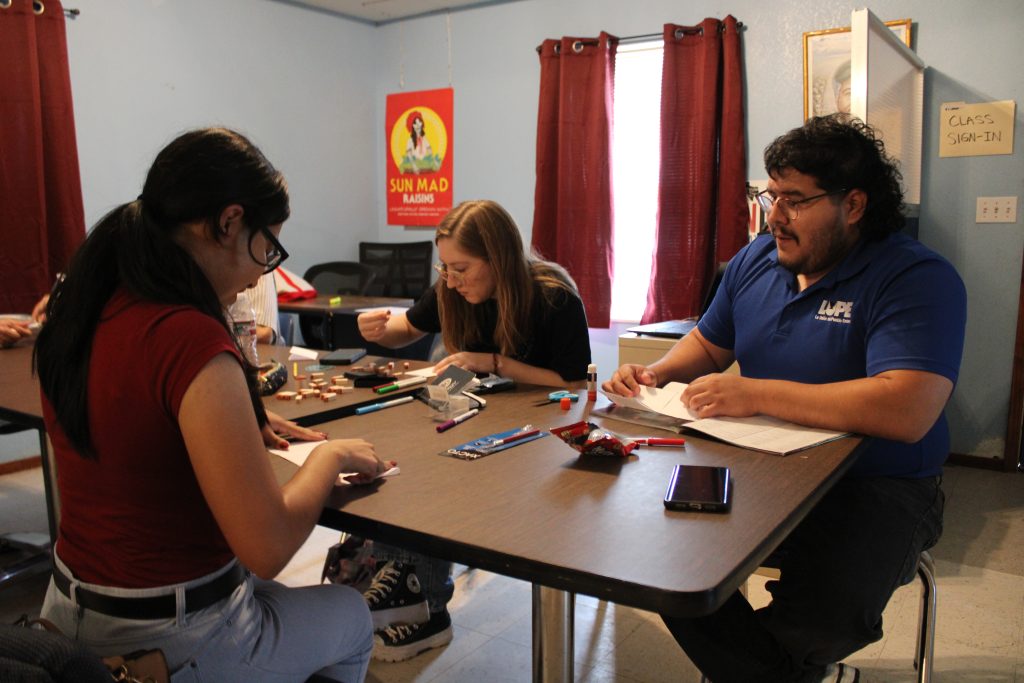
“[I’d] been wanting to do community engagement stuff and workshops, so I think that was the perfect opportunity to do that. So, with that money, I hosted workshops, [and] started collabing with organizations,” Flores Tavizón commented.
The first semester as part of her Resistencia Fronteriza project, Flores Tavizón hosted a screenprinting and poetry workshop in collaboration with the Unfolded: Poetry Project; after that, other similar events came to fruition.
Flores Tavizón was inspired by Keatan McKeever, a classmate of hers who had also received the same fellowship. While McKeever’s project focus differed from Flores Tavizón’s due to McKeever highlighting ecological practices, Flores Tavizón shares that what inspired her was McKeever’s workshops and an exhibition.
For this reason, Resistencia Fronteriza’s first year included workshops and an exhibition at Cactus Valley Art & Supply Company. However, Flores Tavizón admitted that in the second year, she had to tone down Resistencia Fronteriza because it was her last year at UTRGV.
Ultimately, Resistencia Fronteriza is Flores Tavizón’s artistic way to offer a platform for other people by putting together workshops and allowing people to share their own narratives.

Uplifting the RGV Through Artivism
With so much going on due to the Trump administration’s treatment of people who move to a different country in search of a better life, the state of this country needs people who uplift and engage with their community through art and activism.
Flores Tavizón talked about the difficulty of being an artivist at this time, “It’s hard because you do get people [who say], ‘Well, you’re not political enough.’ Because they associate [politics] with […] going to protest, […] being bold in that way. I don’t do all that to protect my status. It doesn’t mean I don’t want to do it, but I don’t want to risk my visa.”
Across the country, people like Flores Tavizón have been experiencing this same fear of wanting to protest and advocate against the unfair situations that keep happening in the U.S. Still, they find themselves with their hands tied by the obstacle of losing their voice to protect their visa and legal status.
If you want to keep up with what Flores Tavizón is doing with Resistencia Fronteriza and are interested in using art as a tool to express yourself through advocacy, there will be a printmaking workshop happening 0n Tuesday, August 26, at UTRGV’s Brownsville Campus.
Support local RGV artists who are doing the work here in the 956!