“Your uncle swam over several times and would routinely cross the border by walking on some pipes in Brownsville that he discovered. He’s the only one to have ever been apprehended, and that’s the reason he was never able to become a U.S. citizen. He got to stay here [through] Amnesty, but there’s something he has to do every couple of years to stay in America. He was a strong swimmer. All of my brothers were, but he was also a great futbolista,” my mother told me one day over the phone.
This story, told softly, suddenly felt urgent after I saw a video of a family reporting to a scheduled hearing at the Immigration Courthouse in San Antonio. The family found out upon their arrival that their case was dismissed, and U.S. Immigration and Customs Enforcement (ICE) officers were on-site to detain the mother, who had no criminal record but was going through the appropriate steps to become a resident of the United States.
The video was heartbreaking. My attention was torn between the young child crying and pleading with her mother to calm down, and ICE agents enacting violence on people who are trying to live a better life. Videos like the one I just described are appearing frequently in daily recaps, and I suspect they’re being discussed privately among other families searching for a better life.
When I later spoke to my mother about the video I’d seen, she couldn’t stop shouting about how their due process wasn’t being respected. I’ve never heard her say the word “derechos” so many times in one sitting. When she calmed down, I finally got up the nerve to ask her a question I’d held back from asking for nearly 50 years.
I asked my mom for some clarity on how she got to America. I admitted that while I’d seen her Permanent Resident card, I’d never truly understood its implications or the story behind it. I knew that she had elected not to become a full U.S. citizen, but I wasn’t sure exactly what her status was.
I’m an American by birth and therefore by right. But I knew that a number of my uncles, cousins, and neighbors hadn’t arrived in the same way, a fact I’ve been ashamed to inquire about my entire life. When you grow up along the border, you’re very aware of the term: “Illegal Immigrants” or “mojados.”
Something, however, compelled me to finally get some insight into what I could only describe as my “Mojado Origins.” It often feels like there’s an unspoken understanding within many minority communities, perhaps an instinct, to never pry into someone’s immigration journey.
I wasn’t entirely sure how the phone call would go. My mom is many things, but she isn’t a snitch. There was a high probability that she would take offense to me asking questions about how certain uncles and she got to America.
I suspected she would respond with a sharp, “¿Estás pendejo? Why are you asking me that—and why on the phone?” followed by an abrupt click. Much to my surprise, she didn’t hang up. I explained to her that I wanted to attempt to record her oral testimony of our “Historia Mojada.” She found that endearing and slowly began to share how she and her siblings made their way to America. She also clarified something that I never understood: the general catch-all expression of having your “papeles arreglados.”
“All of us got here differently…” she said. “Your grandmother, my brother Jorge, and I were all able to come to the United States with a “Tarjeta Local.” Your grandmother knew someone who lived in Reynosa, which allowed her to establish paperwork proving residency in a border town, allowing her and her children to visit America. Back then, as minors, we didn’t have to present identification; I wasn’t 18 yet, so I didn’t have a passport or a visa. I met your father and got married later that year, and that’s how I began my process to become documented. Your grandmother got a Mexican Passport and took the necessary steps to apply for a visa for future visits. One of your uncles also did the same thing, so he always crossed with documents.
Your other uncles, on the other hand, came over in various ways:
- One crossed through Juarez with the help of a Coyote.
- One forged a document, claimed one of your cousins as his, and came over with a Tarjeta Local; he went back after a brief visit.
- One swam across the river (he was an excellent swimmer). He slowly went through the process to become a citizen.
- Another one also swam across the river, but only came over once for a brief visit. Hurricane Gilbert was too much of a bad experience.
- Finally, one swam over several times and would routinely cross over by walking on a series of pipes in Brownsville that he was familiar with. He’s the only one to have gotten caught, and that’s the reason he was never able to complete his citizenship.
It became clear to me that only my grandmother and one of my uncles came to America with “papeles arreglados.” My mom met my father in McAllen, Texas, at the start of 1977. They were both Aries, fire signs, so they naturally found it normal to get married within a year of meeting each other.

My mother went on to tell me a little more about select family members who were also here without papers. I learned this evening that my grandmother (my father’s mother) was undocumented. I learned that one of my cousins might have a cloudy citizenship status as of this evening. I learned that just behind a house where one of my aunts lived, near the Rio Grande border, was often used to not only smuggle immigrants but also traffic captured Mockingbirds into Mexico. Our “Mojado Origin” story, like many other immigrant families, is complicated and fluid.
As my mother took steps toward attaining legal status, my father was more subversive about immigration. Once, on a long cross-country drive, he told me about how he would forge and fix documents for immigrants who were in America through the Bracero program. From what I recall, in exchange for a pair of new shoes, he would help people forge documents so that they could find work further North. He doesn’t know how many immigrants he helped over the years, but he does know that they all celebrate the 4th of July and October 31st (Halloween) as a birthday. He helped people standardize simple dates and origin towns so that if they were ever asked questions about their documentation, they could recite it without hesitation. My father was never caught doing this charitable act, but I remember him telling me that people were suspicious of his growing shoe collection.
Many of my viewpoints and stances on immigration align with my father’s and his lived experiences. A vivid memory I have is looking out our living room window one afternoon and seeing two men sitting in our front yard. My father was a foreman for Valero, but these individuals weren’t in uniform and didn’t appear to be part of the crew he typically worked with. At a glance, they looked like the men you would generally see gathered outside local hardware stores, looking to pick up day jobs. Undocumented workers doing spot jobs in our neighborhood weren’t all that uncommon. When I walked over to ask my parents what that was all about, I caught them in the middle of a conversation. They were Honduran, and my father was going to take them to a local church for sanctuary and to help get passage further North. My mother was horrified by the entire ordeal, but he assured her that everything would be fine and that they would ride in the truck bed, not the cabin. Later that day, my father explained to me why it’s important to help them whenever possible. “The Hondurans literally got to America by foot,” my father said. “They escaped atrocities I couldn’t imagine and weren’t welcome in Mexico.” It’s an odd memory, but it stayed with me my entire life.
At some point during my phone call, my mother asked, “¿Por qué preguntas?”
On my phone, I have one of those “family chat” threads with my immediate family. On said family chat, my sister reminded me that when I was born in 1977, my mom wasn’t a fully documented citizen of the United States. In jest, she reminded me that there’s a chance I could lose my citizenship on any given day.
I admittedly haven’t concerned myself with losing my citizenship, but the absurdity of it all feels a little more real when you see established normalities slip away. I’m developing a growing concern about her well-being and wanted to ensure I understood how her citizenship works.
I’ve been on this earth for nearly 50 years, and whenever we encounter customs or ICE agents in Texas, my mother produces a tattered Permanent Resident card that is always on her person. I’m shocked that its validity has never been questioned. It was given to her in the 80s, and I’d liken it to a high-quality college ID card issued in the same decade. The card doesn’t appear to have an expiration date, and, to the best of my knowledge, she has never been asked to obtain an updated identification card.
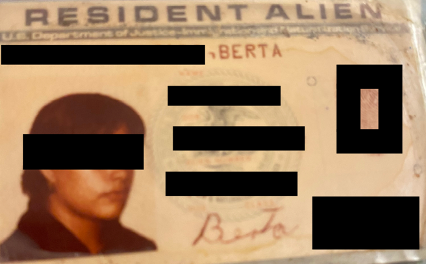
I ended the phone call feeling better about what we discussed and what I learned about my family. I’m no less angry now than I was when I watched the video. I think my mother and I are aware that things could change regarding Permanent Residents living in the United States. I mean, something could change with Birthright Citizenship, too. Yet, within all the uncertainty, we had one of the most healing conversations of our lifetime.