October 2, 2024
Op-Ed: Building Bodies: Machismo and Body Dysphoria
Story by Arin Young
Edited by Nina Alegre and Abigail Vela
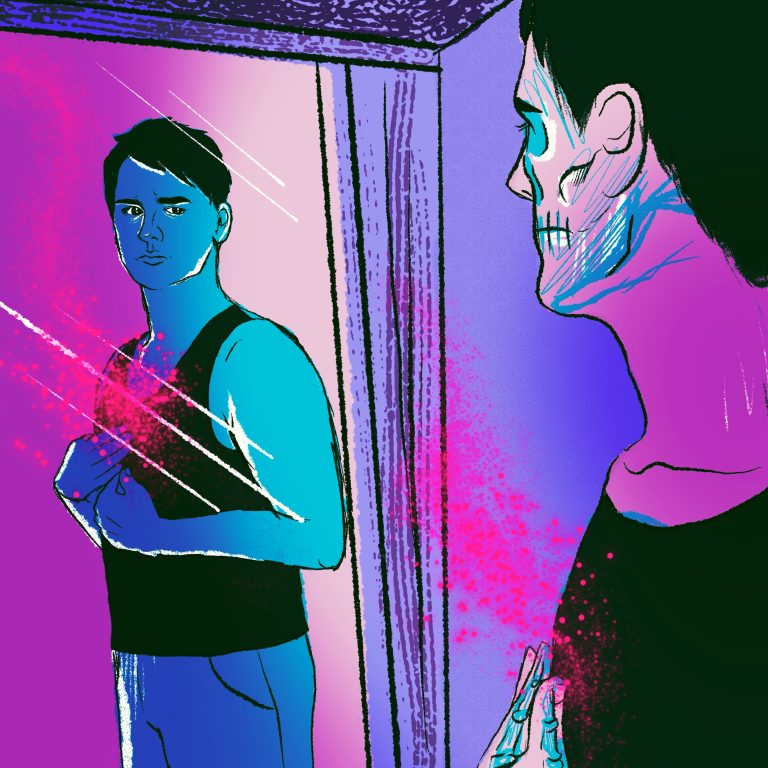
I feel as though I have this desire to function as a man without being a man. But, of course, what would being a man even entail? Do I know? Does anyone?
My name is Arin Young, and I’m non-binary. If pressed, I would describe myself as transmasculine but not necessarily “a man.” Does that make sense? Maybe not. I can talk myself in circles for hours debating the intricacies of my gender presentation. Sometimes, I worry it’s all for nothing, that I have been constructing problems where there is none.
I would like to start by talking about the male body—what it looks like, how to get it and who gets to have one.
The Man’s Man
The desire to emulate powerful men can lead people to ruin. We often see this happen with little boys who don’t know how to be anything other than the man their father is. More often than not, the role of masculinity they inherit is created and informed by the patriarchal attitudes of our society.
What kind of man is favored by patriarchy? We know that in this region, machismo is the dominant expression of patriarchy. Machismo is a common attitude adopted by men that prioritizes male superiority and devalues femininity and queerness.
Here in the Valley, the braggadocious machismo attitude dictates the lives of many men, governing what they can wear, who they can speak to, and how they must conduct themselves sexually.
The ideal male body is typically associated with strength and power. He is the leader of the household, and his body reflects this. He is tall, intimidating by nature, physically built, but he does not partake in excessive grooming rituals. He is self-reliant and wild, an animal that cannot be tamed, always teetering on the edge of violence. He takes great pride in his rough, hyper-masculine traits and will tear down those he sees as lacking in these attributes. He is almost certainly heterosexual and cisgender.
This ‘macho man’ represents a distilled version of toxic cultural ideas about the place and purpose of the male figure. Men are leaders, warriors and breadwinners—to not be this way is to fail at being a man. But the ideal man is simply that—an ideal. One that some men have an easier time living up to than others, he is an ideal that haunts the narrative of masculinity for all.
The traditional masculine body has no room for the experiences of the transgender man. Their lives are unaccounted for in the narrative dominated by machismo culture. So, how do trans men who grow up in this culture redefine masculinity?
Dysmorphia: An Obsessive Fixation With Appearance
Dysmorphia and dysphoria are two words for essentially the same concept. The main difference is that one happens in the bodies of cis individuals and the other in the bodies of trans individuals.
Dysmorphia, or more specifically, body dysmorphia, is a medical term denoting when a subject’s appearance has become an obsessive fixation. Most people have some physical traits they are insecure about, but this becomes body dysmorphia when insecurities become massive anxieties that impede healthy functioning. To alleviate body dysmorphia, subjects develop stringent habits for controlling and modifying their appearance and achieving a desired aesthetic. However, because these anxieties are not rooted in reality, they cannot be adequately addressed without a more therapeutic approach. Those who experience body dysmorphia can find themselves going to incredible lengths to achieve the “correct” body, such as developing eating disorders.
Cis men can develop body dysmorphia surrounding matters such as muscle distribution, gynecomastia (a medical term for the development of breast tissue), hair loss, and numerous other cosmetic variations. Typically, these variations are fairly normal and nothing to be concerned about medically. Still, they can cause a great deal of emotional turmoil for the men affected as these variations deviate from the image of maleness they are expected to adhere to.
Are cis men who address their dysmorphia through medical intervention not receiving a kind of gender-affirming care that is also used to help alleviate the gender dysphoria of transgender people?
Dysphoria: Dissatisfaction With Assigned Gender
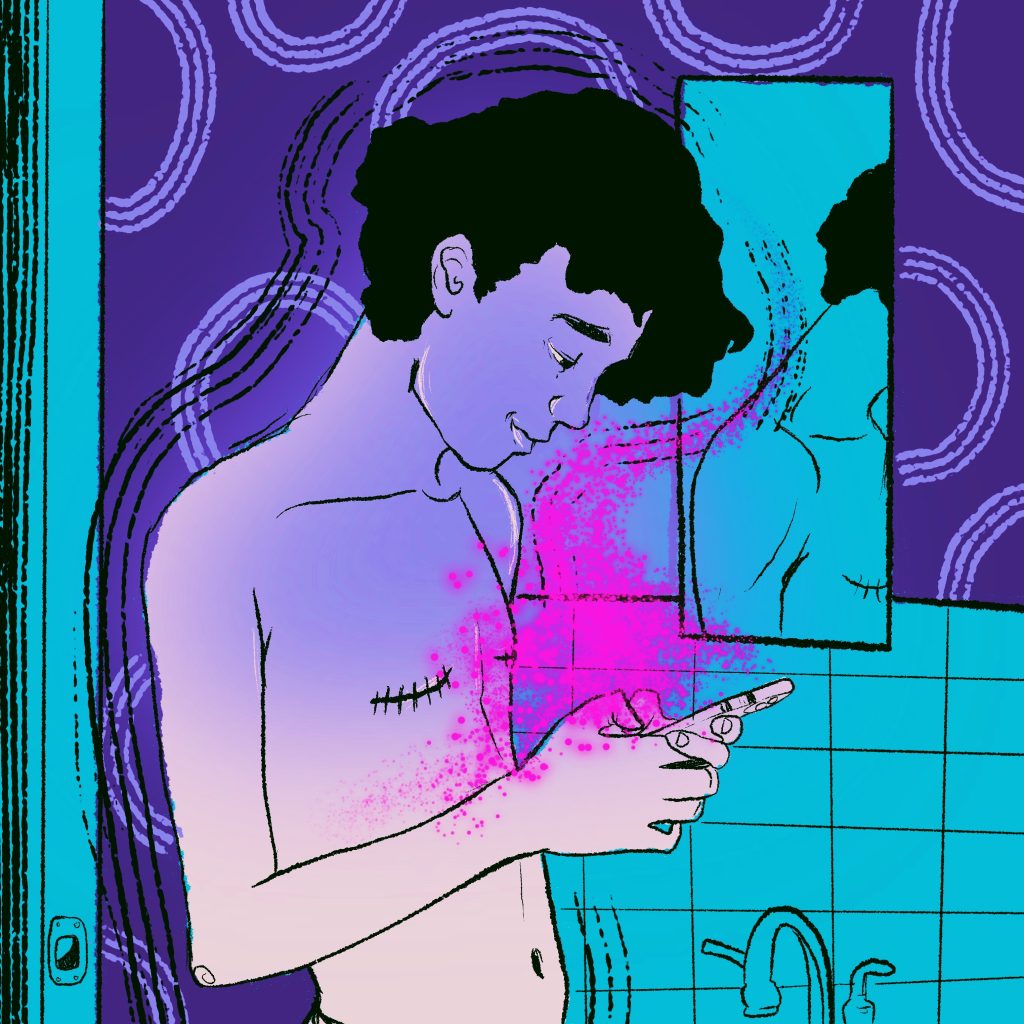
For transgender individuals, dysphoria is the common term used to describe feelings of dissatisfaction with their assigned gender. Trans men, for example, often have feelings of dysphoria around their chest region.
Sebastian Bryan (he/him), a transmasculine tattoo artist in the Rio Grande Valley, recalled a particular moment when, as a child, he watched a group of boys play shirts vs skins basketball at a local park, “It felt different this time because I was focusing on the fact that I couldn’t take off my shirt because it would be inappropriate for my body type to be shirtless. The more I kept thinking about it, I started to tear up. Because it wasn’t about just not being able to take off my shirt but not being able to take off that part of my body. That’s when I realized something was wrong.”
The desire to alleviate dysphoria is many trans individuals’ motivation for seeking medical transitions in the form of gender confirmation surgery like top surgery and hormone replacement therapy.
Bryan has received gender-affirming care in some capacity for several years now, but he admits that the feelings of dysphoria never really go away, and he still experiences feelings of insecurity surrounding his body at times.
Bryan was lucky to have transgender friends at the time to whom he could speak about these feelings and who were able to offer advice and comfort. Bryan is very aware of the necessity of having a good support system when dealing with dysphoria. “You need cheerleaders. You need people on your side,” Bryan said.
Support from others is a lifesaver when navigating transition. It can be hectic and stressful keeping up with insurance companies and all the medical appointments, not to mention the stress of navigating relationships and dealing with insensitive comments. As he transitioned, Bryan mentioned how people seemed to feel emboldened to ask inappropriate and intrusive questions about his body, such as what surgeries he had. This is a common experience for transgender individuals as any sort of deviation from cisnormative body standards is noticed and commented upon by those invested in maintaining the strict delineation between male and female bodies. Acceptance of trans bodies is a crucial part of breaking down these barriers that prevent us from appreciating diverse bodies.
Under the Umbrella: Transmasculine Experiences
Bryan spoke a bit about the difficulties and insecurities that come with transitioning into a new social role. “(Finding out I was trans) was like finding a missing puzzle piece, but then I became aware of all the other pieces on the board,” he said. “Like how do I fit in in a world where men are supposed to be flat-chested? There are these boxes that people try to fit you in and roles you have to play. But I realized that I can still be myself and learn to grow as who I identify as.”
When speaking with Bryan about those who supported him in his transition, he talked about how grateful he was for the support of his older brother, a person he had always known to be rational and supportive. He also made mention of his rockier time in coming out to his father, putting that relationship in the ‘not so positive’ category.
The story of parental disapproval is one all too familiar to young trans people.
Lead organizer for the grassroots trans activism group Under the Umbrella and fellow trans man Adonis Gutierrez (he/him) tells a similar story of a lack of positive masculine role models in life. He remarks that early in his transition, he defined his masculinity against the kind of masculinity he saw in his father. “In my own household, I had personal experiences where my father was very bad to my mom, so that’s when I was like, I don’t want to be like that,” Gutierrez said.
Instead, the kind of masculinity he preferred to model he witnessed in his mother’s telenovelas. A genre filled with romantic heroes who were respectful and protective of the women in their lives.
These conflicting models of masculinity were difficult to navigate. Gutierrez remarks that by attempting to be this kind of man, or rather, by trying not to be like his father, he ended up in relationships where this insecurity was used to victimize him.
It’s clear from Gutierrez and Bryan’s stories that the question of how to be a good man is one with very real stakes. The desire to prove oneself as a man can lead to people placing themselves into boxes instead of living as their authentic selves. Gutierrez and Bryan found happiness and success by choosing to live authentically, but it was not without struggle. Overcoming that struggle required asking difficult personal questions, as well as finding those who were willing to provide support.
Under the Umbrella seeks to provide that support system to the transgender community here in the Valley. As one of the main organizers, Gutierrez envisions Under the Umbrella as a space where the trans community in the Valley can share resources that help them lead fulfilling lives. The organization has recently started a mentoring program to help connect those in the trans community with others who can help them achieve their professional and personal goals and provide support. Gutierrez cites the inspiration for this program as a desire to see an increase in trans individuals represented as successful members of society. For those interested in the work done by Under the Umbrella, Gutierrez encourages you to reach out to the group’s Instagram page.
The narrative around trans lives is often dictated by the cisnormative society, who cannot imagine that some might find happiness and joy in their trans identity. In a time where it seems the only story of transgender life is one of tragedy and loss, it takes courage to be proud and joyful of your transgender identity.
Building a Better Man
For those who find themselves struggling to live up to the expectations of masculinity placed by others, you will not find happiness chasing some lost ideal macho man stereotype. He was always just a cultural pastiche. It is only through allying with and understanding the struggles of trans and gender nonconforming individuals that life outside the rigid gender binary becomes possible.
I’ve struggled with these questions on how to be a good man myself. I wanted to know why being masculine appealed to me so much when every man I knew seemed to be struggling to perform masculinity acceptably. What I have found through speaking with gender non-conforming individuals, transgender men, and cisgender men is that being a good man is less important than being a good person and living authentically.
As a genderqueer person, I understand the lines between masculinity and femininity to be more flexible than cisnormative society would have you believe. Blurring the lines between male and female allows for more creative and authentic gender expressions, but so, too, should we be blurring the lines between cisgender and transgender.
Trans men have had to learn how to be men within a culture that excludes them from participating in masculinity because of their bodies. For cis men who face similar struggles, there is much to be learned from listening to their stories. You may find you have more common ground than you initially believed. Perhaps you will see your own attempts to redefine masculinity reflected in the stories of your transmasculine community members. Together, we can reshape these harmful gender roles. In the end, masculinity is a flexible concept. What it means to be a man is something you have to discover for yourself.
Support RGV Storytellers.
Rio Grande Valley storytellers need your support. Trucha, a 501c(3) non-profit, provides artistic opportunities to the community, with the help of our donors. Your contribution will help us continue our mission to empower our creative community of storytellers.