The RGV Broadband Coalition is Taking a Stand Against the Digital Divide
Story by Abigail Vela
Edited by Leo Rodriguez

During this time and age, almost everything we utilize requires some sort of internet connection: our computers, phones, laptops, cameras, televisions, tools, kitchen appliances and more! However, not everyone is as connected as we think.
According to the Federal Communications Commission (FCC) Broadband Map, the Rio Grande Valley is now 96% connected to fixed internet. But this could not be further from the truth. Organizations and judges in the Rio Grande Valley are currently challenging this map because many people in our region, including those in our communities who live in colonias and/or rural areas, experience poverty in both, physical and digital, landscapes.
How the Digital Divide Affects the RGV
The Rio Grande Valley Broadband Coalition is a group of organizers and partners whose mission is to build digital equity and access in the region and close the gap on the digital divide: the divide between communities who do and don’t have access to digital technologies that are crucial for academic and workforce opportunities.
Trucha’s Development Director and coalition member, Leonardo Rodriguez, shared, “The RGV Broadband Coalition is united in challenging the dominant narrative that fuels the digital divide in our region. Our mission as a coalition is to provide equal access to digital education and workforce opportunities for everyone, regardless of their location or income level.”
The coalition met on Tuesday, December 3, 2024, at the headquarters of La Unión del Pueblo Entero (LUPE) in San Juan, Texas, to discuss the Texas Broad Band Development Office (BDO)’s quick turnaround challenge through the Broadband Equity, Access, and Deployment (BEAD) Program.
Under the Infrastructure Investment and Jobs Act (IIJA), the Texas BEAD Program is giving the state $3.3 billion to expand access to broadband internet access. It is important to note that the FCC Broadband Map is used under the IIJA, which ultimately determines the locations that qualify for broadband investments, grants, and funding.
However, broadband service providers, local governments, tribal governments and non-profits only have less than two weeks left to apply to the BEAD Program, which is already underway and will close on Tuesday, December 17. The two weeks is for the coalition and our community affected to challenge the map the Texas BDO will be using to determine eligibility for BEAD funding. This process will last until April 2025, which includes rebuttals of the challenges submitted.
Members of the Rio Grande Valley Coalition expressed that this time restraint was purposely created to limit the organizer’s opportunity to reach out to people on the ground and online to petition that the FCC Broadband Map is, in fact, an inaccurate representation of the amount of digital access present throughout the Rio Grande Valley region.
“We are working to dismantle current policies that have led to underinvestment in our area, advocating for programs and infrastructure funding that foster a healthy, thriving community for our people,” Rodriguez said.
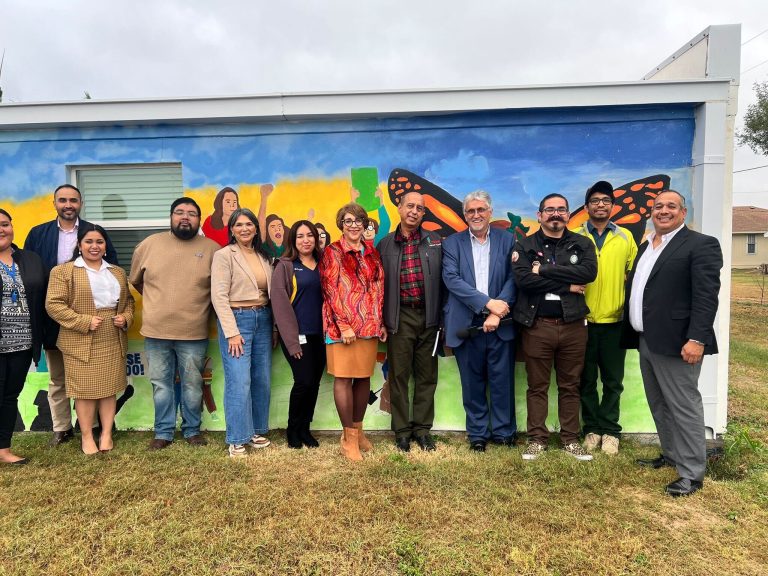
On September 26, 2024, Hidalgo County Judge Richard Cortez sent a letter to Texas Comptroller Glen Hegar urging the BDO and the National Telecommunications and Information Administration (NTIA) to reject the use of the FCC Broadband Map to determine if Hidalgo County meets criteria for broadband funding, due to the map’s inaccuracy.
In the letter, Judge Cortez stated how “the digital divide is a barrier to the economic competitiveness of the United States and equitable distribution of essential public services, including healthcare and education.” He further goes on to share that “the RGV has one of the greatest digital divides in the country” and “the [FCC Broadband Map] deliberately excludes vital information, such as actual active household subscribers to fixed broadband.”
The letter contained statistics from the U.S. Census showing that in 2022, only 36.1% of households in Willacy County and 42.9% in Cameron County had fixed broadband subscriptions, showcasing proof of the digital divide present in the RGV. In addition, according to the 2022 American Community Survey, 54.6% of Hidalgo County residents had fixed broadband subscriptions and Starr County had 51.4%.
How Can You Help Bridge the Gap in the Digital Divide?
Take a stand and help the RGV Broadband Coalition close the digital divide!
Residents in the Rio Grande Valley can take a stand today until Tuesday, December 17, 2024, and petition the current FCC Broadband Map. Rio Grande Valley residents are encouraged to share their opinions about the issues that directly impact their digital access, such as pricing, connection, lack of connection and slow speeds.
When you fill out the form, you will need to:
- Select your current location
- Input type and type of connection issue
- Share details with connectivity you are facing
- Show evidence and documentation of issues
- Attestation or confirmation that what you are saying is true
Fill out the form and share your voice on www.lupenet.org/BEAD.
For troubleshooting guidance: http://register.broadband.texas.gov
tel:8558392323 (855-TEX-BEAD)
Support RGV Storytellers.
Rio Grande Valley storytellers need your support. Trucha, a 501c(3) non-profit, provides artistic opportunities to the community, with the help of our donors. Your contribution will help us continue our mission to empower our creative community of storytellers.