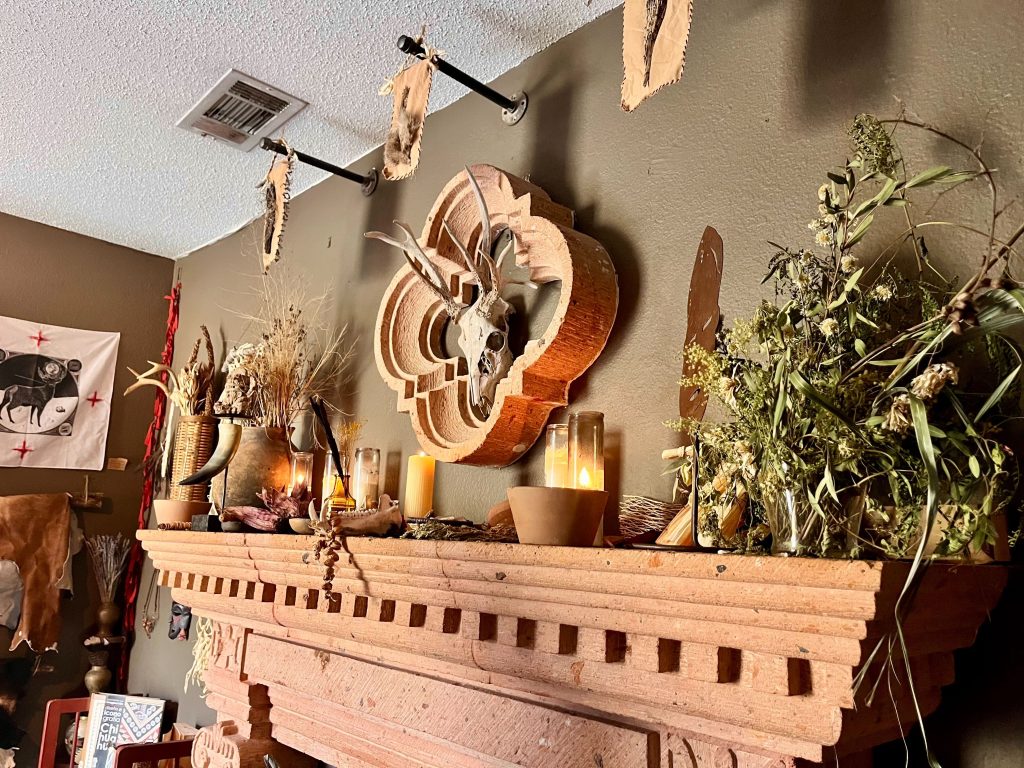
Small white pouches containing tobacco in a basket alongside a red clay statue.
Tierra Mojada's studio space offers a variety of locally sourced goods and artesanias. Photo Courtesy of Melissa Cortes Santiago.

Tierra Mojada: Reconnecting with the RGV’s Ancestral Roots

Story by Melissa Cortes Santiago 

Edited by Abigail Vela

The first time Angie Rocha stepped into a studio to get a handpoke tattoo from Loba, an artist she had met at a jewelry-making class a year prior, she left with a piece that covered most of her neck. The handpoke session, free from the buzzing of a machine, was tranquil and allowed for something special to emerge, a conversation that was rooted in shared memory and connection. 


“One of the beautiful things about tattooing without a machine is that there’s no noise other than us talking to each other. And it’s slow, so there’s a lot of time to unpack,” Loba, a handpoke tattoo artist, said.


That first session became the beginning not just of many more tattoos but of kinship. A bond that would later grow into Tierra Mojada, a studio space and land restoration project in the Rio Grande Valley. What began as a connection between two artists became a deeper commitment to return to their ancestral lifeways, to protect and restore native ecosystems, and to create a sanctuary where plants, animals, and people can exist connected to one another.


“The shop is our effort to start to be merchants again, to start to make artesanias again and also offer space to the community for other people who want to either learn or also share their knowledge and their experiences,” Loba said.

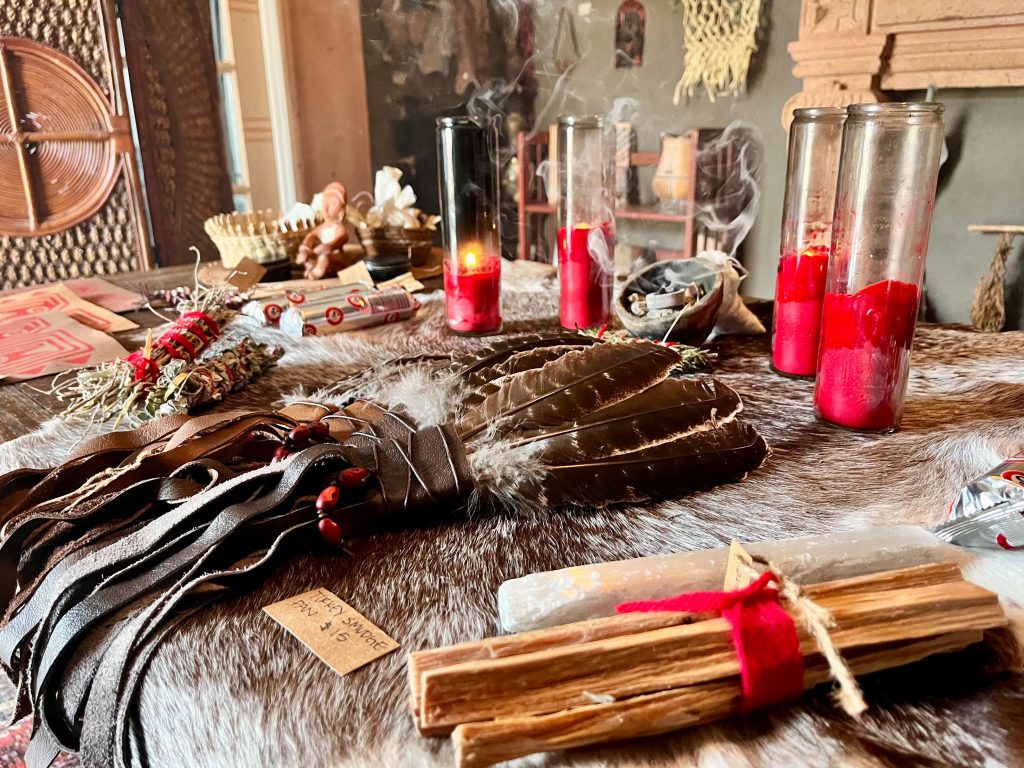
An altar adorned with a variety of locally sourced goods.
Photo Courtesy of Melissa Cortes.
A wooden log with necklaces made of clay and bark hanging around it and white vaquero hats on the side.
The studio offers a variety of artisanal products, all crafted from materials sourced in the RGV. Photo Courtesy of Melissa Cortes.

How Tierra Mojada’s Mission Blossomed

Angie (she/her) is an environmental educator and artist whose practice centers on the land. Her approach seamlessly weaves together storytelling and art-making, utilizing locally sourced plant materials and traditional techniques. 


“A lot of my work focuses on environmental historical education of our lands and the lands of our ancestors,” she said.   


Loba (she/her), a hand-poke tattoo artist of eight years, entered their practice through a journey of self-healing using traditional knowledge and medicine. As she began learning more about conventional medicine and plants, she began to understand what had been lost in her lineage due to assimilation and systemic oppression. 


“These eight years of offering tattoo as medicine to people who have a similar cultural background like me have really turned into this kind of reclamation of the fact that we are more than just our nationalities,” Loba said. “We’re not just Mexican. We’re Indigenous people.”


The studio Loba and Angie created, Tierra Mojada, meaning wet earth, draws on that layered mixture of ancestral knowledge and ecology. Angie describes the symbolism: when the Rio Grande meets the soil, it becomes mud, malleable, alive, and full of possibility. 


“There’s so much that seeps into our very being,” she said. “It’s that liminal space we try to navigate… something not ever super solid, but not ever just super flexible.”


While the studio space offers tattoos, altar decor, traditional arts, locally sourced goods, and medicine, as well as a gathering space, Tierra Mojada’s mission extends far beyond its walls into the 10 acres of land in Monte Alto that the group is slowly working to restore.

Feather fans bound with a leather wrap used for altar decoration.
Photo Courtesy of Melissa Cortes Santiago.
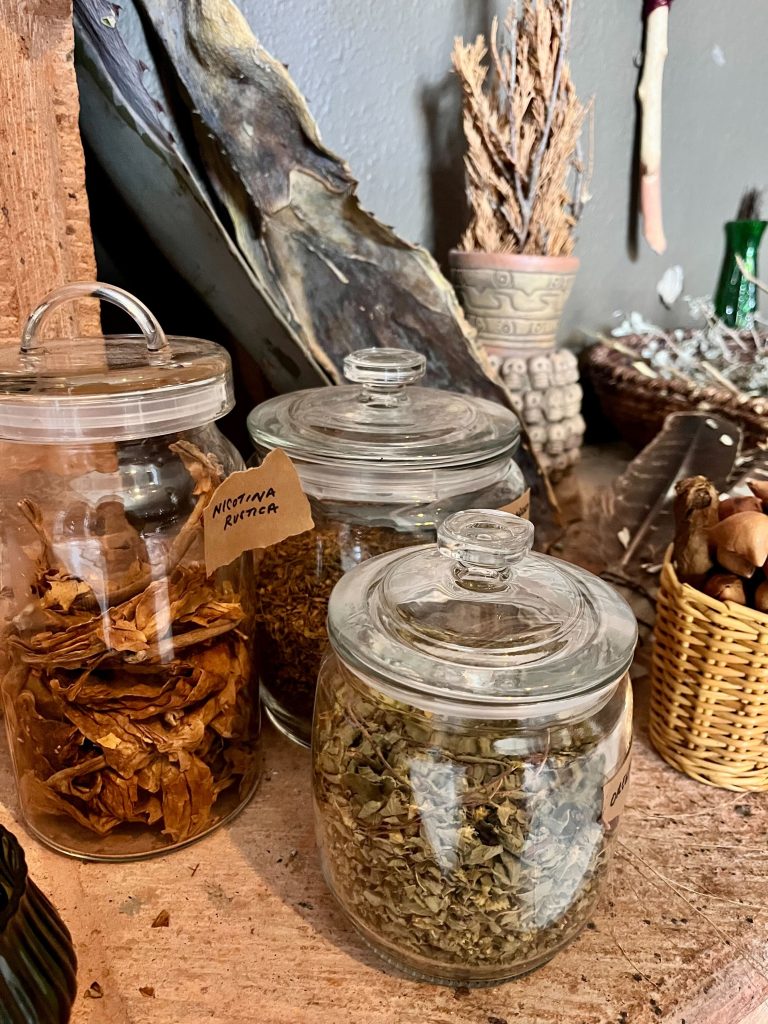
Glass jars containing nicotine and tabaco.
Photo Courtesy of Melissa Cortes Santiago.
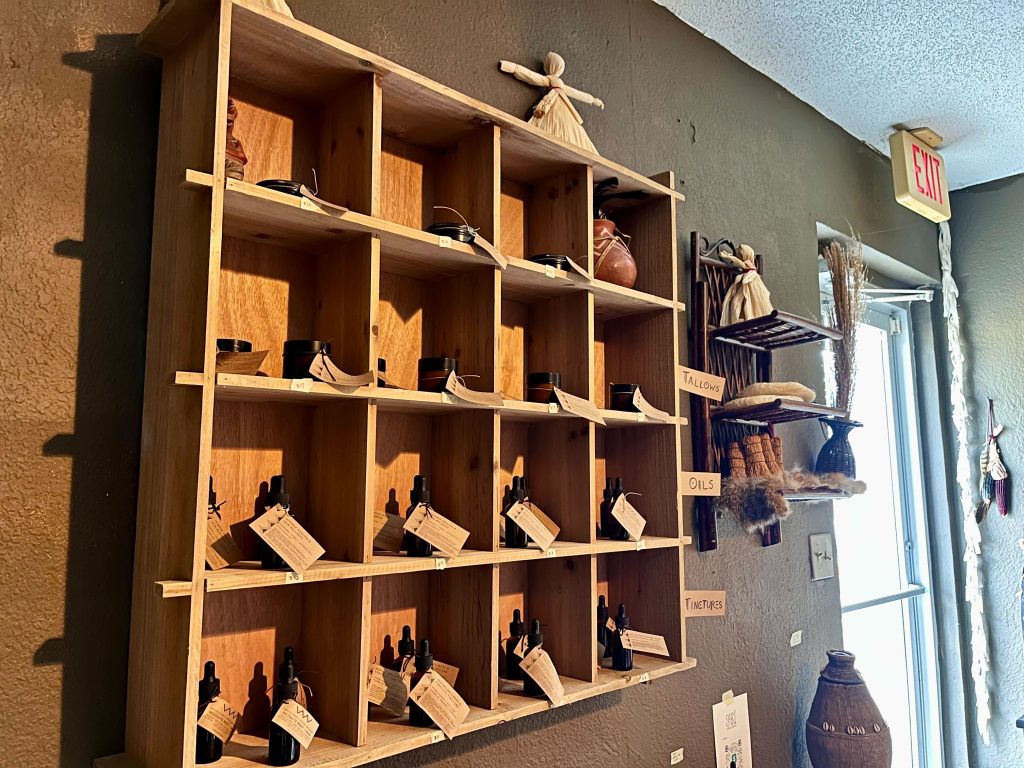
A wooden display with various medicines.
Photo Courtesy of Melissa Cortes Santiago.

Their goal is to restore the Tamaulipan thornscrub, a native ecosystem that once covered much of the RGV. It is an essential habitat for more than 1,200 plant species, 500 bird species, and 300 butterfly species. However, due to excessive agriculture and industrialization, only about 10% of the native thornscrub remains. 


“The thornscrub forest has taken care of us in so many ways, infinitely, and we see our responsibility as stewards of the land to restore this beautiful ecosystem for ourselves and our animals,” Angie said. 


That land, once drilled for oil, is now being turned into a sanctuary for endangered plants, animal migration routes, and community gathering. They are working with animals to graze and fertilize the soil before planting. The project includes native cactus restoration, educational workshops, and eventually, facilities for people to come, gather and connect. 

“This is all by design,” Loba said, reflecting on the systemic forces keeping people disconnected. “[The system] keep us distracted. [The system] keeps us hustling. [The system] keeps us from the land, from realizing who we actually are.”


Tierra Mojada is resisting that design by working on this project slowly and intentionally. 


“We’re not here to just push big projects,” said Loba. We’re here to build real relationships with people we live with.”

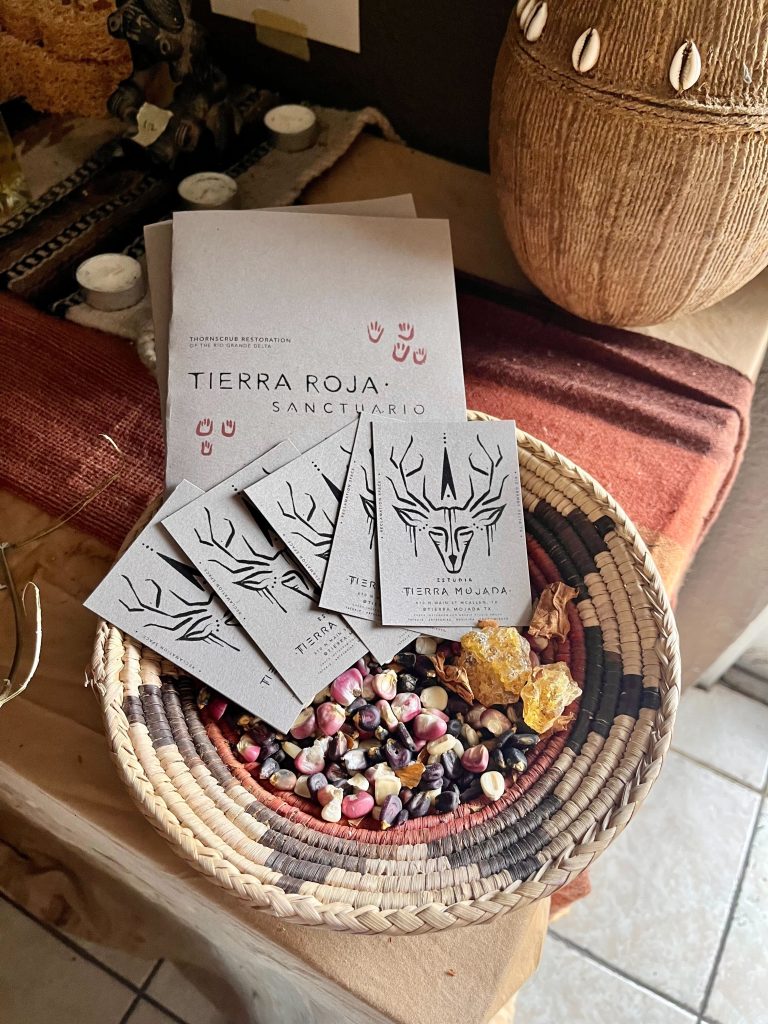
Gray pamphlets in a woven basket adorned with corn.
Reading material available in the studio space to learn more about their restoration efforts. Photo Courtesy of Melissa Cortes Santiago.

Spreading Ancestral Knowledge Through Grassroots Efforts

One way they’re building those relationships is through their Reclamation Days, monthly gatherings where community members are invited to share and learn traditional knowledge, such as corn husk weaving, tattooing as a form of medicine, and ancestral hair braiding. These events offer a space for people who may feel disconnected from their roots to reflect and reconnect with their heritage. 


“There’s nothing to relearn,” Loba said. “It’s just a remembrance.”


As the RGV is increasingly being industrialized by large corporations like SpaceX and LNG, the work that Tierra Mojada is doing is urgent and necessary. What began as a familial bond between two people has become a mission to teach our community to reconnect with the land, each other, and with histories that have long been pushed aside. Through education and community efforts, Angie and Loba are creating a space that offers a space for healing and deep connection. Their work reminds us that reclaiming ancestral knowledge is not just personal, it’s political, environmental, and collective. 


To support and learn more about Tierra Mojada’s reclamation and restoration work, visit their website or stop by their shop. Become a part of the movement to restore ancestral lifeways in the RGV.

Support the Frontera

We rely on generous donations to publish original works each year and support artists in the Rio Grande Valley. Our community's voices are essential in shaping the history and narrative of the frontera!

Donate

Related Posts

Witnesses & Witches: Suspiria (2018)

March 4, 2026

This Cine Trucha review on Suspiria deals with themes of motherhood, repression, and femininity, as well as systems corrupted from…

Meet RGV Band LUEME

February 28, 2026

Experience the transformative sound of LUEME, a reimagined indie-alt band from the RGV experimenting with a mix of genres.

An Ode to Ante Books

February 17, 2026

Ante Books closed its doors, but its legacy lives on. Discover the impact this unique bookstore had on the community.

View more

newsletter

This field is hidden when viewing the form

Next Steps: Sync an Email Add-On

To get the most out of your form, we suggest that you sync this form with an email add-on. To learn more about your email add-on options, visit the following page (https://www.gravityforms.com/the-8-best-email-plugins-for-wordpress-in-2020/). Important: Delete this tip before you publish the form.
Name(Required)