Whole Lotto Nothing
My dad never hit it big, but I have rich memories of him playing Texas Lotto.
Story by Erasmo Guerra
Edited by Abigail Vela
- August 28, 2025
Whenever the Powerball jackpot nears a billion, I can hear my late dad’s plea to try my luck. He’s been gone nine years this Labor Day, but I don’t think I’ll ever forget how obsessed he’d been late in life with hitting it big.
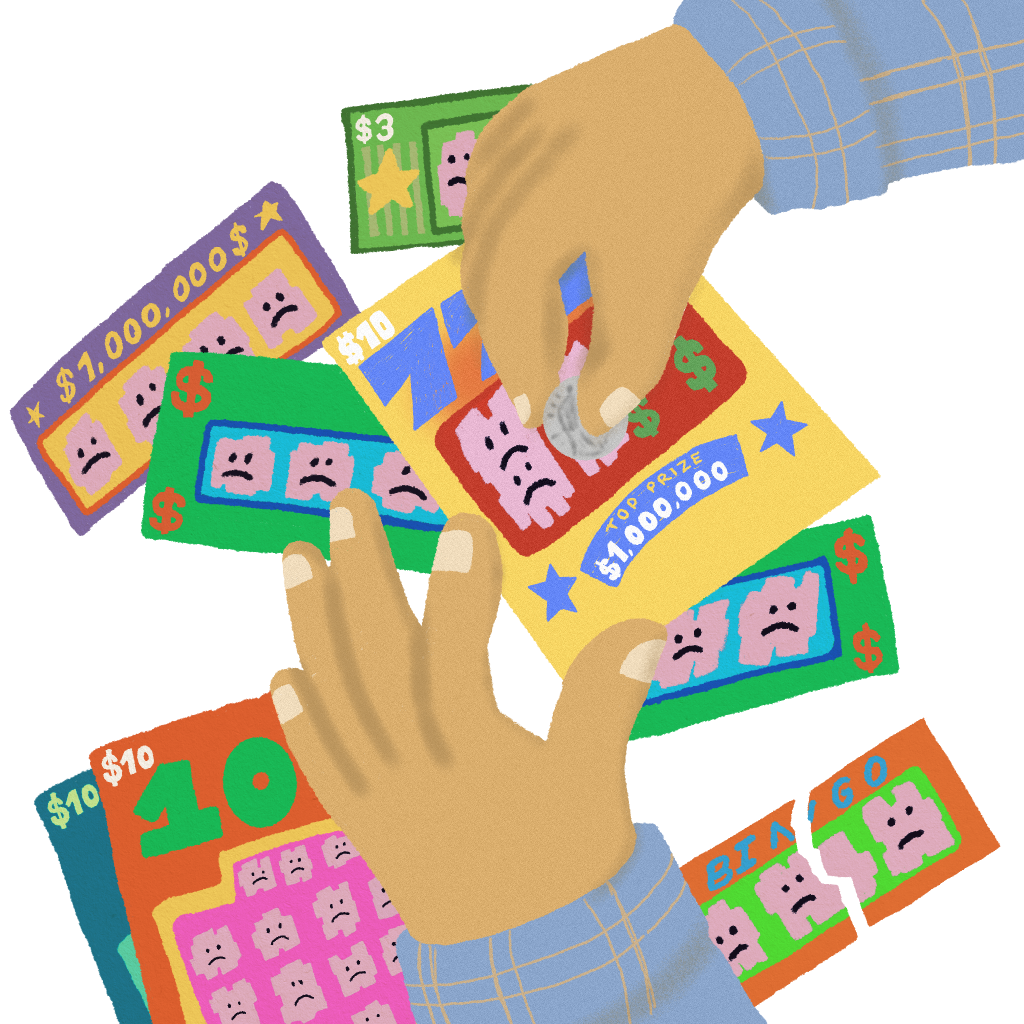
I’ve lived in New York City ever since I went away for college, but whenever I returned home to the Valley for a visit, there was always a rat’s nest of “Cash Celebration” scratch-off lotto tickets littering the floor of my dad’s F-150. The game pieces were sun-bleached and faded, curled by the South Texas heat.
They were losing tickets. But whenever I rode with him, I felt compelled to ask, “D’you win anything?”
“I’m lucky they didn’t make me pay.” He always said that with an amused snort.
Maybe he didn’t feel the pinch when he played a dollar at a time, but lotteries have always had a negative impact on low-income communities of color like ours. A hippie high school teacher, a white guy with a Jheri curl, who had moved to the Valley from Michigan, had argued this point in our tenth-grade civics class. State-run lotteries that funded public schools and state projects were played mainly by working-class people of color, which made it a tax that unjustly burdened communities already struggling under income inequality.
My dad was a working-class, first-generation Mexican-American with a dark sense of humor. Most of his jokes were about growing up poor. (“I’m so broke I can’t even pay attention.”) He was a blue-collar guy who worked twenty-plus years as a telephone repairman for Southwestern Bell. He’d been an Army vet who did two tours in Korea. And before that, he’d been a migrant farmworker who picked cotton as a child and who sometimes spent the summers up in Michigan picking seasonal crops.
And although he had a healthy pension when he retired, along with his social security check, childhood poverty must have left him feeling financially uncertain his entire life. On my weekly calls home, as a kind of bendición at the end, my parents always mentioned that I should play the lotto, going so far as to encourage me to spend anywhere from one to five dollars a week.
“I don’t want to make it a habit,” I argued.
“It’s not a habit. It’s just five dollars a week,” my mom reassured me. She had also grown up as a migrant farmworker, picking cotton, and was forced to drop out of school in the fifth grade to help support her family. “Uno nunca sabe,” she said. You never know.
What I did know was that the only folks I saw lining up outside the sidewalk newsstands or corner bodegas to buy games were blue-collar workers. Postal employees pushing mailbags. Construction workers in sweat-soaked safety vests. Immigrants in black-and-white check pants that seemed to be the uniform for kitchen workers.
My folks nagged me for years. And they saw my refusals to play as more of my weirdness, like, how I no longer watched broadcast news, had picked up yoga, including headstands (“¡Te vas a lastimar el cerebro!”), and had become a vegetarian (“Do you still have that vegetarianism?” they asked every time I visited).
Were they just worried about me? Their wild hope that a lottery win would provide the financial windfall that freelance writing had not. It’s not like I ever asked them for money. But I never sent them any either.
Whenever I did go home, my dad refused to accept my disinterest in money and always suggested getting breakfast at a place called United, where, he said, “The coffee’s bad, but a few people have hit the lottery there.”
He forgot the exact figures for any of the pay-outs. Or the cumulative total of awards. But he guessed it was in the millions.
“Whatever it is,” he said, “it’s better than being broke.”
The breakfast spot turned out to be a convenience store in Mission at the One Mile Line, or, as we used to call it, El Uno. The location had more than a dozen gas pumps and a rear junkyard that was part of the adjoining Mission Salvage Center.
Inside, at the back, we ordered breakfast tacos at the kitchen window. My dad poured himself a Styrofoam cup of coffee, winced as he took a sip, and then motioned for me to pay up at the cashier by the front door.
As I paid, I asked the woman behind the register for a scratch-off game and pointed to one called Hot Numbers with the letters in flames. When she handed me the change and the game piece, she seemed to slow down, looked me in the eye, and said, “Good luck.”
Feeling creeped out, but also somehow blessed by luck, I headed back to my dad sitting in one of the yellow booths. Along the way, I noticed that every person I passed had a mess of game pieces and lottery ticket receipts scattered around them.
My dad scratched the game with his truck keys. He read off the prize with an awed whistle, “Up to six thousand dollars.”
When he found out that we had no matches—not even two like numbers—he tossed the card to me.
He drank his coffee and grimaced, flicking his tongue out with each sip. He didn’t dwell on his luck—or lack of it—nodding in the vague direction of worse circumstances and told me about a friend from the old neighborhood.
“Poor guy,” my dad said. “His sons—hijuesu—in and out of jails, or holed up with him.”
For a moment, I wondered what folks said about us, his kids. The oldest died at a young age. The next one is a non-conforming queer kid who left home to take a gamble at a life in the arts. And the last one, the baby, is still living at home like he was 13 and not in his 30s.
Having finished breakfast, my dad lit a cigarette outside and took a hard drag. He shot out a stream of smoke as he glanced at the junk at the Salvage Center. The front sidewalk was cluttered with empty store shelves, ripped-out school lockers, and wire animal cages and traps. He looked both disgusted and delighted by the mess. “They go to auctions and buy all kinds of stuff,” my dad explained.
That was another of his get-rich-quick schemes. He spoke about driving upstate, combing flea markets, and reselling his finds here or vice-versa. The only problem? He hated traveling. He didn’t like dealing with people. And he never really had a good eye for anything.
Still, he said, “My thing is pictures.” He recalled a cardboard print he’d recently bought at a garage sale. He was convinced it was a Rembrandt. He heard there were some “lost paintings.”
Maybe. But I doubted they were works on cardboard.
My dad took a final drag on his cigarette and then flicked it out. “I like lamps, too.” He’d seen one in Raymondville that had, he said, “pictures of George Washington.” He sighed, releasing a plume of smoke. “I should’ve bought it, but I didn’t know if it was antique.”
Sometimes I’ve thought that what he really didn’t know was what he wanted to do with the rest of his life after he retired and his working life was over. Some days, he didn’t have the enthusiasm for anything. He sat on the sheet-covered recliner in his jeans and white V-neck, his socked feet stretched out before him. He scratched his sunburned neck, his skinny arms with their faded tattoos, and took noisy slurps of reheated coffee. Now and then, he leaned forward, the coffee cup still in his hands, and he took on the vague image of a man pleading for alms.
My mom sensed whenever he wasn’t himself.
“Wanna go to the pulga?” she’d say, anything to just get him out. He’d grunt.
“You don’t wanna just go see?”
He’d grunt a more decipherable “No.” Never mind that his whole get-rich-reselling plan would’ve forced him to make a regular circuit of the local flea markets.
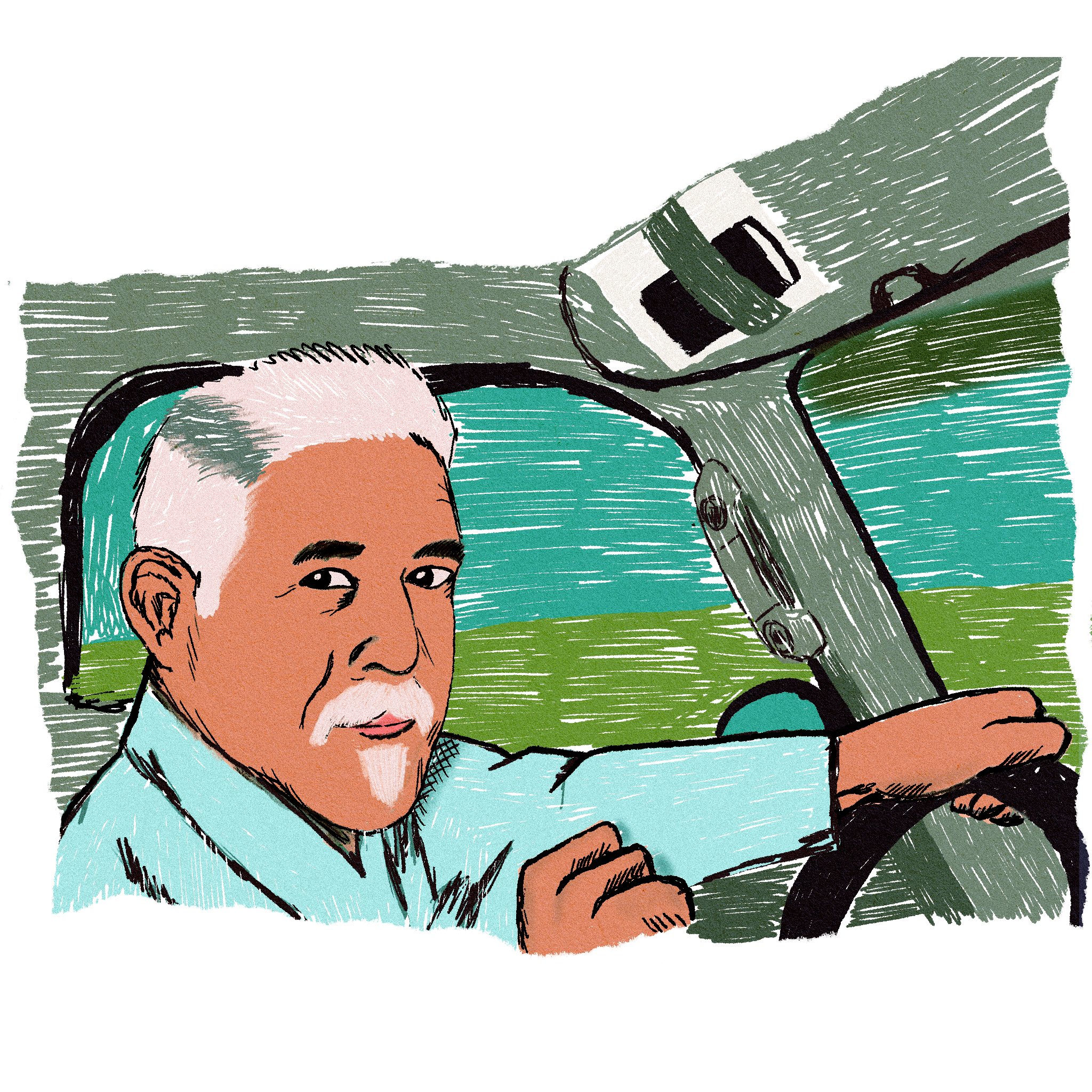
Nearing the end of one of my visits, my dad came up to the cashier as I paid for our breakfast at a taco counter inside a gas station.
She was ready to return a dollar in change, but my dad tapped on the glass counter, where the wheels of lottery tickets spun underneath. “Give me one of these and we’ll call it even,” my dad drawled.
He could lay on the charm when he was feeling it. The cashier tore off a game piece.
Back at the table, my dad used his truck keys to scratch off the prize box first. Each game piece could win up to $6,000 in cash, but our box said it was worth one dollar.
Disappointed, my dad muttered, “It’s not even worth scratching.” But he went on playing anyway, scratching the other boxes. The worst part of it?
We won—matching two like numbers, a pair of sevens. He tossed the winning ticket to me. “You can have it,” he said. I slipped it into my back pocket.
Alarmed, he said, “You’re not gonna cash it? You can trade it for another game.” I told him we could redeem it tomorrow, before I left for the airport.
But tomorrow came and I flew away, taking the ticket with me to New York, where it got left in the wash and tumbled into irredeemable tatters, like memories you try to piece back together because that’s all you have left.
Erasmo Guerra is a Lambda Literary Award-winning novelist and the author of the nonfiction story collection “Once More to the River: Family Snapshots of Growing up, Getting Out, and Going Back.” He was born and raised in Mission and now lives in New York.
Introducing our new series: In The Spotlight: Más Que Papeles. This series highlights the stories of people who arrived in the Rio Grande Valley seeking safety and a better life beyond immigration status. Whether folks are here for the long haul or temporarily, we want to share your 956 experience! We want to show the varied realities of how our neighbors, friends and family are impacted by and face the immigration system. Whether you are an asylum seeker, a DACA recipient, an international student, an aspiring citizen, or not, share your story with us to pitches@truchargv.com.