July 5, 2024

Dispelling the Myth: The Complex Reality of our Immigration System

Words by Melissa Cortes 

Edited by Abigail Vela and Freddy Jimenez

Election season looms on the horizon, and although voting won’t officially begin until November 5 (mark your calendars), certain issues are sparking debate amongst voters. A recent Gallup poll revealed that 28 percent of Americans considered immigration the most important problem facing the nation. Whether or not you categorize immigration as an actual problem, it’s certainly at the top of voters’ minds, and it’s essential to make sure our community is well-informed on the issue. 


December 2023 set the record for the number of migrant crossings at the border. Despite a significant drop in encounters since then, misleading rhetoric about how people can enter this country persists in the media and even within our social circles. If you think there’s a “right way” for people to enter the U.S. or that coming into the country is an easy and stress-free process, think again! 

The reality is that our immigration system is far from straightforward. It’s a complex and challenging maze of paperwork and bureaucratic hurdles, not to mention the lengthy wait times. Truth be told, the restrictive nature of this system furthers oppression, especially in mixed-status and border communities like the Rio Grande Valley. By drawing on insights from experts at the Texas Civil Rights Project, we explore the arduous journey faced by those seeking to enter the U.S. and debunk the myth of “easy entry.”

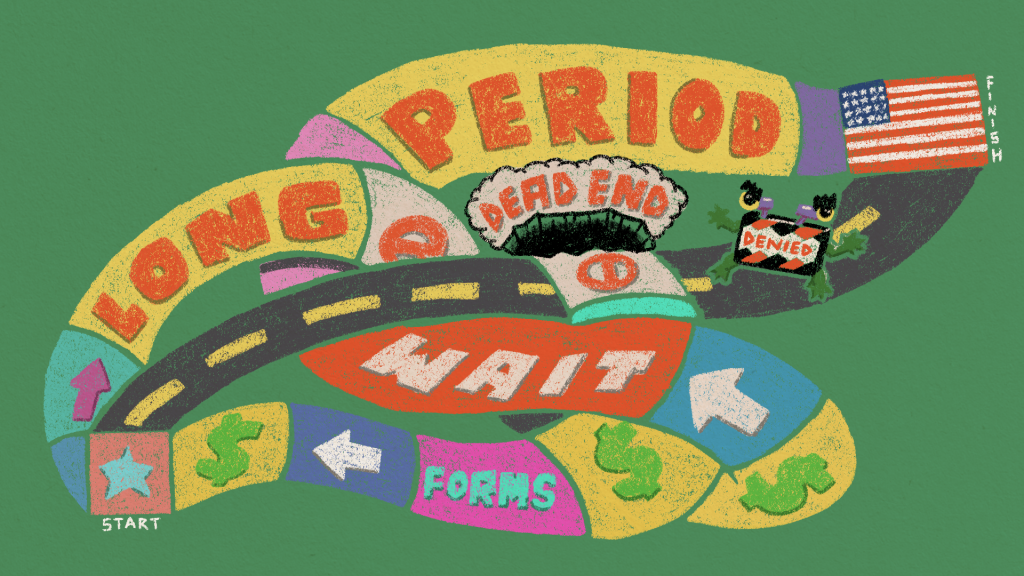
A whimsical and colorful graph that follows the tedious process of applying to enter the U.S. the “right way.”
Illustration by Sandro Galicia, aka Face 2 Face Art.

Ways to Actually Get into the U.S.

There are essentially three major categories of entry into the U.S.: family-based, business-related, and humanitarian-based. These categories have their own subcategories and respective visas and permits. All of which require filling out complicated applications and submitting tons of paperwork. 


“Our immigration system is very broad and very flawed, unfortunately. We do hear that rhetoric [the myth of easy entry] a lot, specifically also from members of our community who don’t quite understand how one is able to obtain citizenship in this country and how one is able to seek asylum or seek some other type of visa,” explained Denisse Molina, the humanitarian outreach coordinator for Beyond Borders Program at the Texas Civil Rights Project


Molina’s insights underscore a critical point: each immigration case can be extremely complex, and fitting into one category does not guarantee easy entry into the country. Even for those with family ties in the U.S., the path to legal entry is anything but straightforward. Family-based immigration requires a U.S. citizen or permanent resident to petition for their relative, a process which involves extensive documentation and can take years or even decades! The process can also be inaccessible due to expensive filing fees. Depending on the specific situation, it can cost up to $3,000. 


“That’s kind of the misleading part. That folks think that you just go to an office or that you just send a paper and that somehow that’s going to lead to citizenship, but that simply does not exist,” said Molina. 

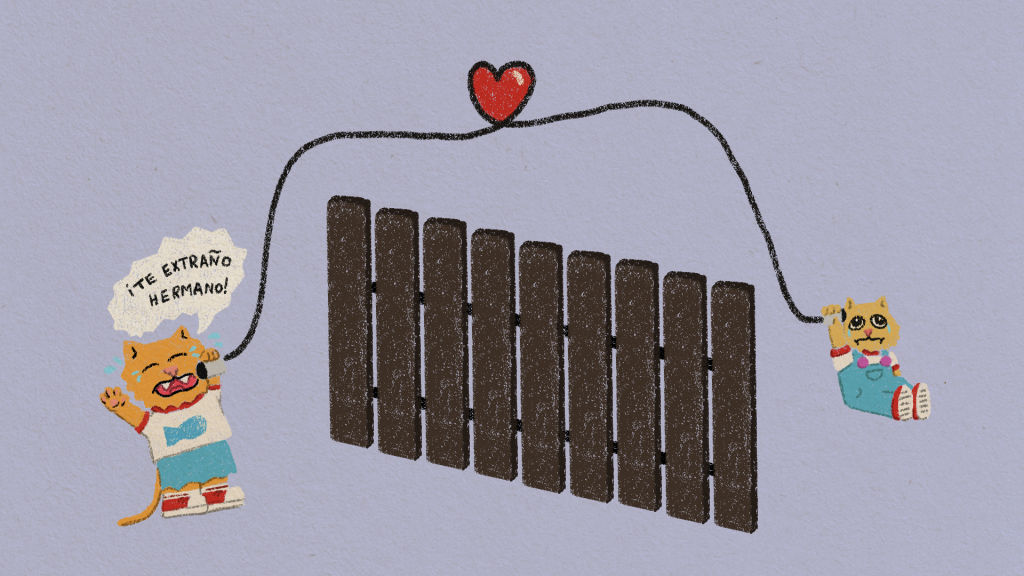
Two characters are separated by a barrier, communicating through a microphone and expressing how much they miss each other.
Illustration by Sandro Galicia, aka Face 2 Face Art.

The situation isn’t much easier for those seeking work-related visas. According to Molina, these visas are highly competitive, with demand far exceeding supply. The intricate application process can often deter people from applying. 

Those who are fleeing persecution and seeking asylum face a daunting process. Applicants must provide substantial evidence of their claims and navigate complex legal requirements, all while facing a high risk of denial. The National Immigration Forum reports that asylum seekers can wait over six years for their cases to be heard.

Now, with a new executive order passed by the Biden administration at the beginning of June, asylum claims are temporarily suspended until the number of crossing drops below 1,500, putting many immigrants at risk. 

For context, in the RGV alone, officials encountered close to 8,000 people trying to seek asylum in May. Many of these people fled their countries to escape violence and economic uncertainties. These people, who’ve traveled thousands of miles and faced a dangerous journey, are now being turned away or made to wait.

A Broken System

The hurdle is that our politicians continue to play with our communities, and immigration’s a hot topic in this election. And I hope people, instead of blaming immigrants who are here or coming to this country, put the blame on the politicians who refuse to pass humane legislation to fix our entire system for everyone,” said Molina. 


Our immigration system is not only flawed, it is in desperate need of comprehensive reform. The long delays, financial burdens, and uncertainty all contribute to a system that all but ensures to keep immigrants out.  We must ask ourselves if that’s the kind of country we want to be. 


As election season approaches, it’s crucial for our community to understand the realities of immigration in the U.S. The myth of easy entry is just that—a myth. By understanding that, we can better advocate for a fair and humane system. So next time you hear someone say that entering the U.S. is easy or that there’s a right way, consider telling them about the countless people still stuck in a broken system trying to make that a reality.

Mira Más

Gente y Cultura

Weaving the Patterns / Tejiendo la Tierra: A Three-Part Series

Weaving the Patterns / Tejiendo la Tierra is a collaborative three-part series presented by Unfolded: Poetry Project, ENTRE, and Trucha, in partnership with artist Diana Lizette Rodriguez of Calle Soledad Presa, that invites the community into an immersive creative process that moves across disciplines, including poetry, bookmaking, experimental film, and performance. Learn about the series of events planned out by the team of collaborators!

Read More »
Illustration of a zine being cut up by sissors.
Gente y Cultura

Be Gay, Do Zines!

Learn about the LGBTQ+ history of zines in the Rio Grande Valley and how community members from Never Before Zine are encouraging people to explore themselves in the art of zine making.

Read More »
Gente y Cultura

CO(O)PING: Rage, Community, and Art

From February through March, the Ponte Gallery Creative Studio & Gallery orchestrated a calendar of art and community workshops that culminated in a one night exhibit and celebration in April called “CO(O)PING!” Learn more about the process from one of the artists who participated!

Read More »

Support the Frontera

We rely on generous donations to publish original works each year and support artists in the Rio Grande Valley. Our community's voices are essential in shaping the history and narrative of the frontera!

Donate

Related Posts

Hoppers: The Passion of Defending the Environment

April 27, 2026

In this collaborative review from Cine Trucha, Nina Alegre and Latifah Khuffash examine Hoppers, a comedy/sci-fi animated film. They explore…

PPST Releases Self-HPV Tests to Help Bridge Healthcare Gap in the RGV

April 22, 2026

Find out how Planned Parenthood South Texas is confronting cervical cancer through education, accessible care, and self-HPV tests!

ICE Leaving Some Airports After Partial Shutdown

April 21, 2026

Immigration and Customs Enforcement (ICE) agents have finally begun leaving some U.S. airports.

View more

newsletter

This field is hidden when viewing the form

Next Steps: Sync an Email Add-On

To get the most out of your form, we suggest that you sync this form with an email add-on. To learn more about your email add-on options, visit the following page (https://www.gravityforms.com/the-8-best-email-plugins-for-wordpress-in-2020/). Important: Delete this tip before you publish the form.
Name(Required)