Growing up in the “borderlands” is a unique experience. You could attempt to explain to an outsider what it’s like, but it would still not contain all the complexities and nuances that make up the life of a person growing up with two cultural identities. Existing in a “somewhere” between here and there, at the crossroads of where you come from, everything you will ever be, and the social expectations you will experience along the way.
The term “intersectionality” was first coined by American civil rights advocate and scholar of critical race theory Kimberlé Williams Crenshaw in 1989 for the University of Chicago Legal Forum. Intersectionality is the idea that the individual experiences and knowledge of society are shaped by multiple social standpoints at once. Marginalized groups experience heightened levels of injustice, so someone who is part of more than one marginalized group will inherently live a more socially complex and oppressed life.
Gloria E. Anzaldúa’s seminal book, “Borderlands/La Frontera: The New Mestiza,” contextualizes the complex identities possessed by those that exist at not just physical borders but the borders of language, sex and culture. Anzaldúa theorized the concept of “invisible borders.” Invisible borders are the psychological, social and cultural barriers people face to be a part of a community. Undeniably, this tension Anzaldúa gives name to deeply shaped her as a queer Chicana artist and is something that runs deep through every queer artist living in a borderland at the intersection of their queerness and cultural identity.
Internal and External Conflict of Queer Identity
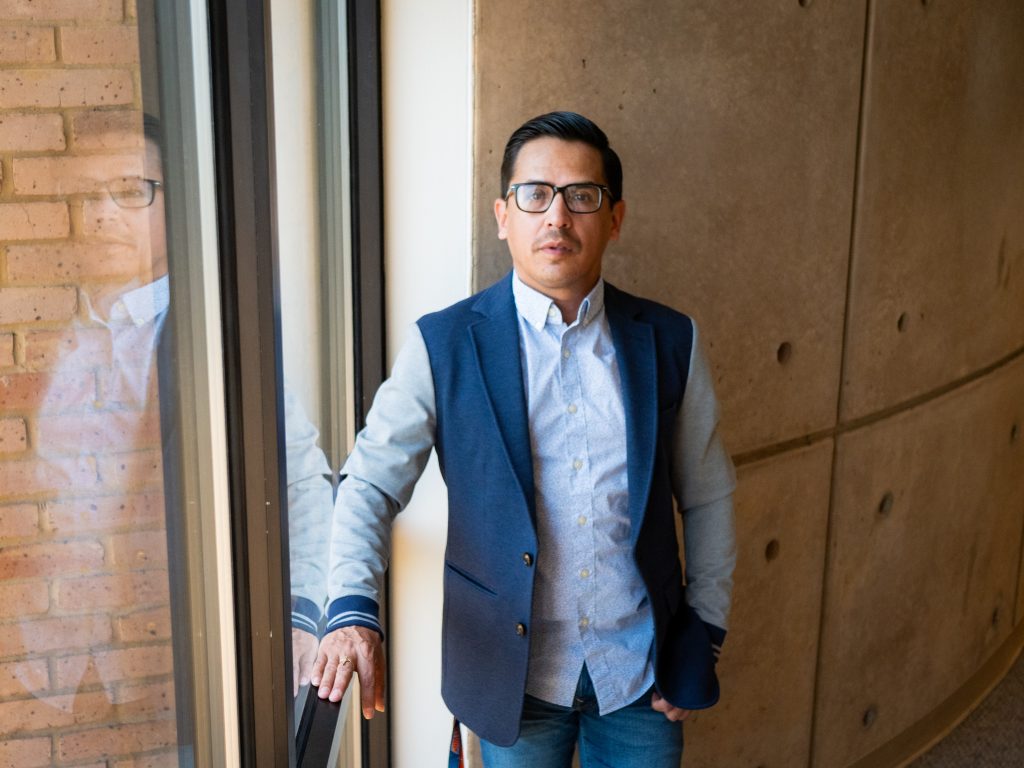

“It’s this whole combination of things that you’re just like, ‘where do I fit in?’ Even [on] the border,” said Valley-based poet Juan Gabriel Mendoza (he/him), as his life reflects this experience. Growing up in a working migrant family, Juan Gabriel and his family moved through the Midwest, following the crops and their seasons.
For Mendoza, discrimination was with him everywhere he went, first in Idaho, where he was born, then when he moved to Oregon and finally when he came to the borderlands and settled in Edinburg. “The thing is, you don’t think you’re different until people make you feel different,” Mendoza said.
Not only did Mendoza have to deal with a geographical transition, but when he finally settled in the Rio Grande Valley, he felt the internal conflict between his culture and his queerness. “The transition for me was incredibly hard knowing that internally I was also quote-unquote ‘different’, ‘cause I was struggling with that as well. Coming from a Mexican, [machista], migrant family, it’s like, my God, what more can change?”
In his early 20s, Mendoza took time away from school to move back to Iowa and do migrant work. Even among the rolling corn fields of Iowa, Mendoza explored his queer identity by tapping into his creative expression. “I would write a lot, doodle a lot, paint a lot, always find some time to do something, but it just wasn’t there because I was also struggling with my gayness. You know that queerness,” he explains, “—like, how do you talk to your parents about it? How do you meet somebody who loves you and understands you and wants to spend their life with you?”
Pop Culture as an Avenue for Reflection

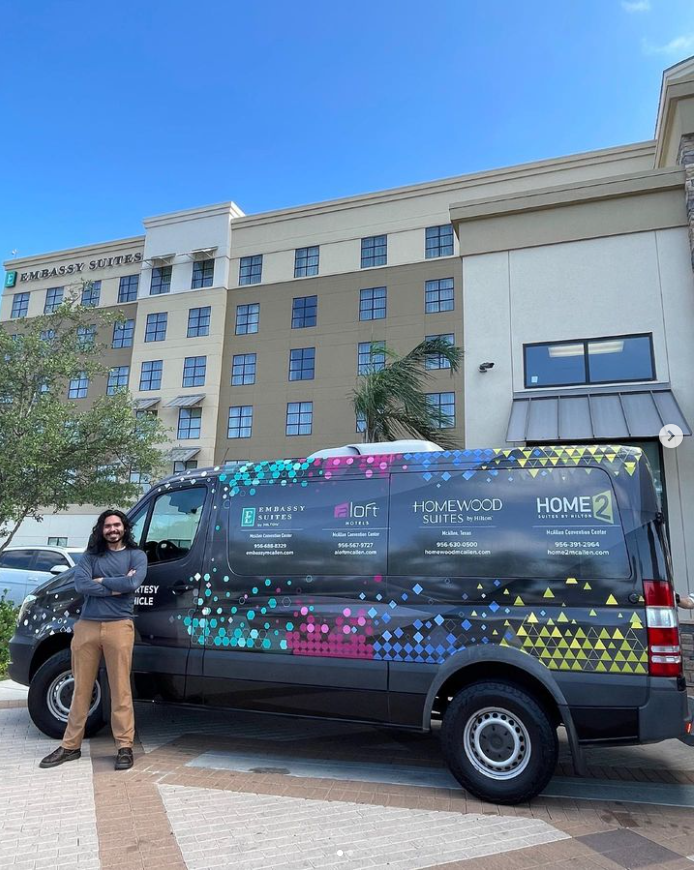
For artists, especially in the queer community, this search for identity is a shared experience. At the intersection where the city of Mission meets Palmview, 24-year-old graphic artist Osbel Olivares (he/him) found his artistic awakening through social media, where he met other queer artists also exploring their identities. Even as a teen, Olivares recognized the lack of representation of queer artists who mirrored his cultural background.
When he was 15 years old, he watched “RuPaul’s Drag Race” star Valentina express pride in her identity as a Mexican. “Seeing Valentina being her queer self on TV during that time–it wasn’t prevalent, and I would see her talk about gender. It’s not like a binary thing, and that got me thinking, it got the wheels turning, and she would always have a representation of her Mexican culture all the time.”
Valentina being open with her trans identity and proudly performing routines that celebrated her heritage gave Olivares powerful reinforcement into his queer and cultural identities. “That got me thinking like, I don’t have to shove it to the [side] just to be accepted by the Americans or Mexicans. Like if I wanna cut it up in a Mexican queer style, I can. Because it’s political, it’s always a statement if you’re queer and proud of your nationality and like you don’t have to reject it just because you’re queer.”
Navigating Complex Identities Through Art in the Borderlands
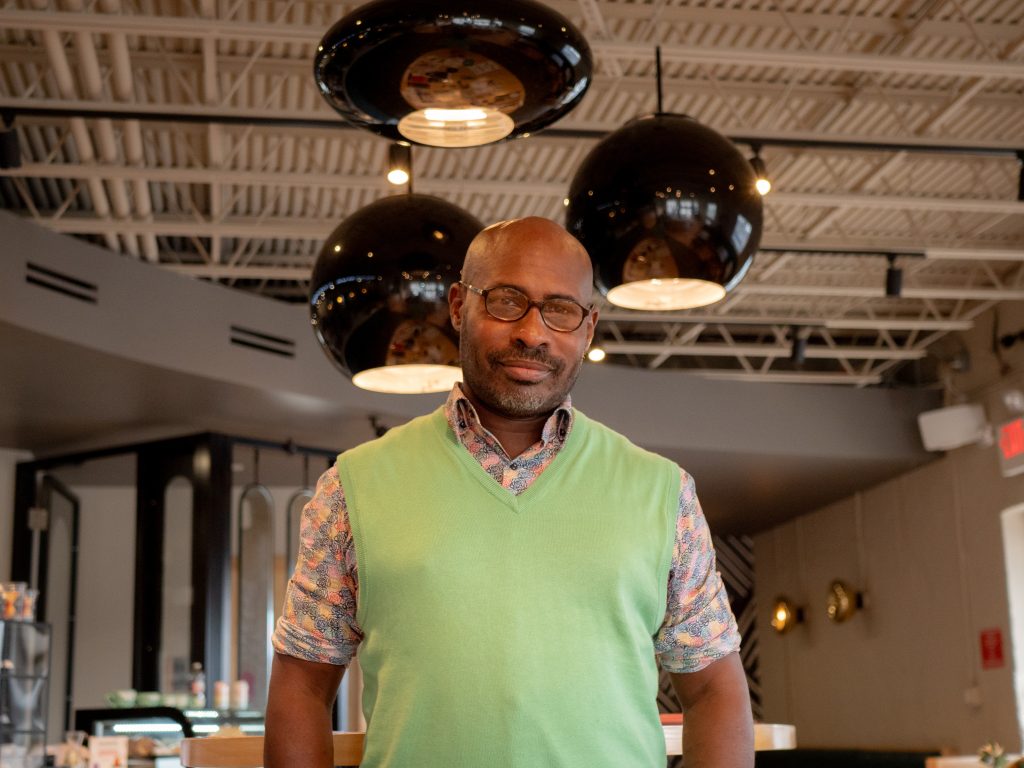
The borderlands are more than just tension between cultures. They can also provide a unique space for those who migrate here that can awaken their artistic voice. Michael Jones (he/him) is a queer black artist “born and bred” in New England. He moved to New York for graduate school, where he explored his artistic expression through forms of poetry like haikus and haigas, which are a combination of haiku poems and visual images.
In 2006, he moved to the RGV, where he’s lived since. As a Black and queer man, Jones finds it difficult to evade the social connotations his racial and queer identity draws. “I was telling a friend once, no matter what, throughout my day–I don’t get a break. I always have to wonder if somebody is saying something to me because I’m gay or because I’m black.” This social hyperawareness follows Jones wherever he goes. “They’re not communicating with me. They’re communicating with me being black or me being gay.”
Jones explains that one of his few privileges, his education, has ironically also turned into a social disadvantage. “When you’re educated—that can be a prejudice with people because they think you’re always talking down to them. James Baldwin once said he was black, gay, and poor, and he hit the jackpot–I hit the jackpot because I’m black, gay, and educated,” Jones explains the pressure he feels to present himself a certain way according to who he’s around. He finds himself in a constant state of having to validate his multiple identities, whether it’s people asking if he watches “RuPaul’s DragRace” or the ways in which he does or doesn’t participate in black pop culture. “It gets exhausting when you have multiple identities that you have to kind of balance.”
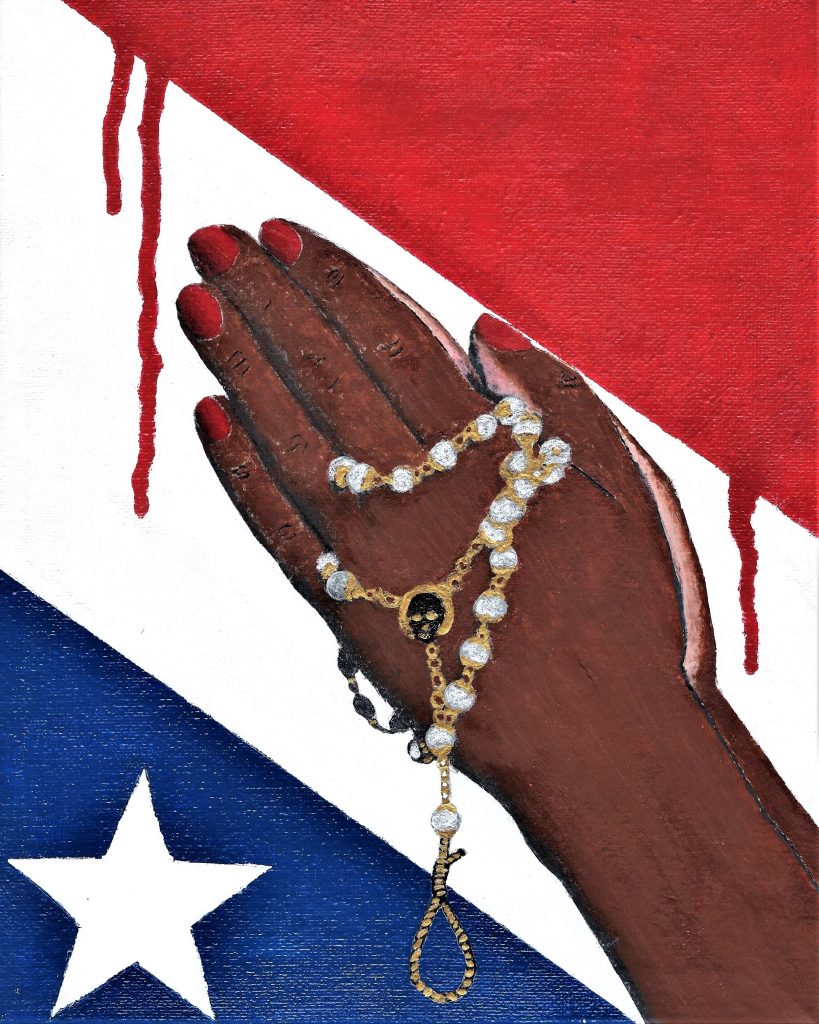
Though Jones is never afforded a break from these performative expectations, he’s able to express and meditate on his anxieties through his art. Jones’ paintings mirror the prejudices he’s faced all his life. One painting depicts a black man in a police knee choke hold, similar to the execution of George Floyd. Above the graphic scene is the lettering “African Horror Story”.
“Our Psyches Resemble Our Border Towns”
At the intersection of their queer and racial and ethnic identities, artists like Mendoza, Olivares, and Jones use their creative expression as a means to break through not just physical but internal barriers.
As Anzaldua theorized, for all ethnic and racial backgrounds, “our psyches resemble our border towns and are populated by the same people.” Being able to illustrate and reflect on the internal conflict one battles at the avenue of all these identities is a gift because living on a borderland is a unique experience, and like any place, ensuring those who are marginalized are able to exist without prejudice is the seed to cultivating an ever-flowering borderland.
Support RGV Storytellers.
Rio Grande Valley storytellers need your support. Trucha, a 501c(3) non-profit, provides artistic opportunities to the community, with the help of our donors. Your contribution will help us continue our mission to empower our creative community of storytellers.