Editor’s Note: MK asked to be identified by her initials to protect her privacy due to the personal and legal sensitivities surrounding reproductive healthcare in Texas. She shared her story to shed light on the realities of reproductive healthcare in Texas, where patients and providers continue to navigate fear and uncertainty.
In Texas, pregnancy has become increasingly dangerous. A recent ProPublica analysis found that the number of women who died in hospitals during pregnancy or shortly after giving birth rose by more than 50 percent between 2018-2019 and 2022-2023, even as the national rate declined. The same investigation showed a surge in preventable complications such as sepsis, which spiked among women hospitalized for second-trimester pregnancy loss after the state’s near-total abortion bans took effect. The procedure is now only allowed when a patient’s life is considered to be at risk. The vague wording has left doctors hesitant to act in medical emergencies, fearing prosecution if they intervene too soon.
Nearly half of Texas counties are now considered maternity care deserts with no obstetric providers or hospitals offering labor and delivery services. The Rio Grande Valley is especially at risk, with a high uninsured rate as well as dwindling access to reproductive healthcare in our communities, forcing many patients to navigate pregnancy and pregnancy loss with confusion and fear.
A Personal Recounting of Miscarriage Under Texas’s Restrictive Abortion Laws
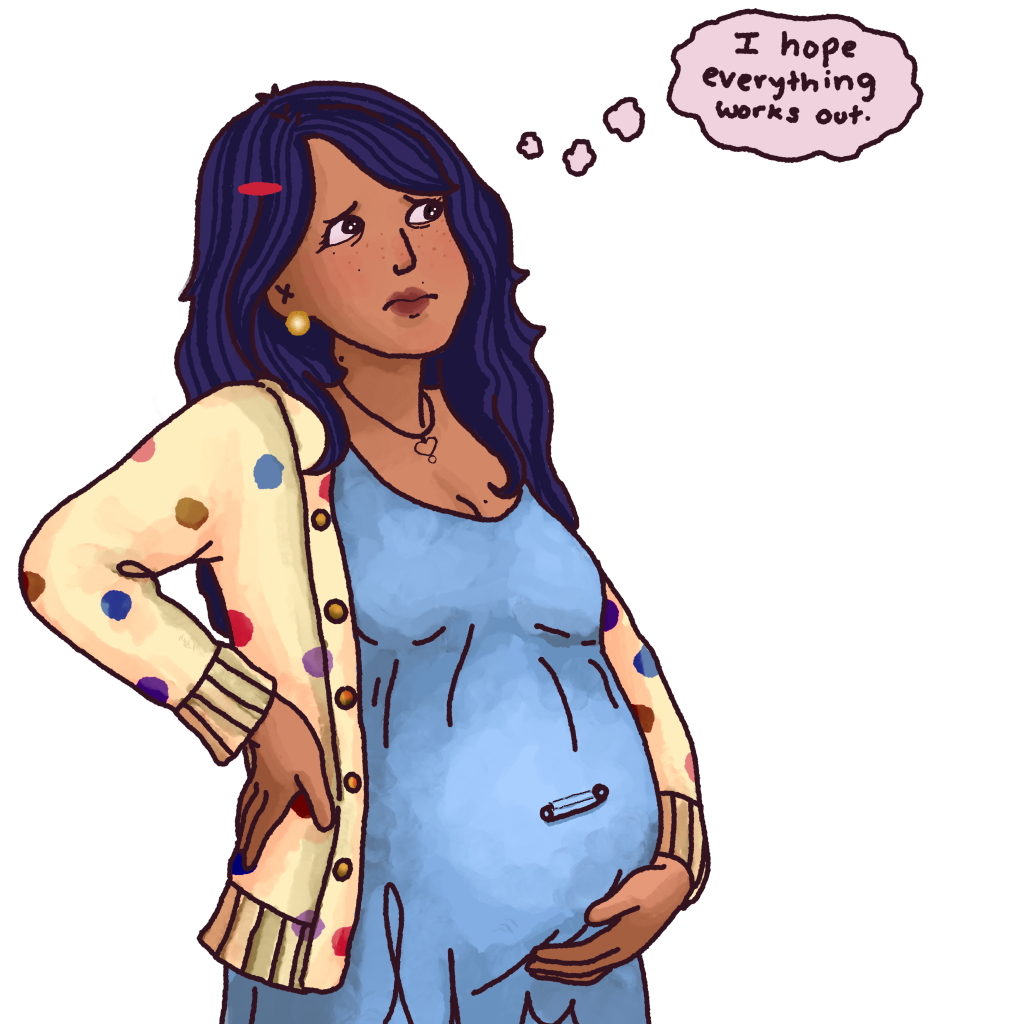
That fear and confusion were prevalent when MK (she/her), an RGV local, experienced a miscarriage last year that required medical intervention. When her doctor confirmed her pregnancy wasn’t viable, MK expected to begin treatment immediately, but due to the current laws in Texas, she was forced to wait.
“It was two weeks of still feeling pregnant, knowing that there’s nothing growing inside of you,” she said.
Abortion is banned in nearly all circumstances in Texas except when it is a medical emergency and the mother’s life is at risk. But the language is so vague that even when a pregnancy has no chance of survival, doctors are not able to act. Fear of prosecution, license loss, or civil penalties has made medical care uncertain.
“My doctor knew this wasn’t a viable pregnancy, but because of the laws, her hands were tied,” MK said.
When MK was finally prescribed medication to complete the miscarriage safely, she had a difficult time getting her prescription at the national pharmacy chain she went to.
“The pharmacist immediately looked at the prescription and said, ‘No, I can’t give you that,’” she recalled. “He wouldn’t even guide me, like, where can I go? What can I do? He just walked away.”
A pharmacy technician quietly intervened, directing her to another location that filled the prescription without hesitation.
“When you’re going through something sensitive and a healthcare provider isn’t being helpful, it makes it a lot more difficult,” MK said.
Her experience reflects a system that leaves patients to navigate the consequences of laws based on fear and stigma.
How a Local Doula is Rebuilding Trust Through Community Care
The prejudice and uncertainty MK describes aren’t unique. For many, the laws have deepened an already existing mistrust between doctors and their patients, especially for people of color and low-income families who often feel dismissed or unheard in medical settings.
Yarlett Navarro (she/her), a certified doula based in Brownsville and founder of Mujeres Poderosas Birth Services, says many of her clients share that mistrust of traditional medical settings. A doula is a trained professional who provides continuous physical, emotional, and informational support to a mother before, during, and shortly after childbirth.
As one of the few practicing doulas in the region, Navarro supports clients throughout pregnancy, labor, and the postpartum period. She offers education and advocacy classes and describes her work as helping women reclaim confidence and choice in their own care.
“Most of the time, especially first-time moms, they don’t know,” she said. “They assume everything the doctor is telling them is in their best interest, and sometimes, unfortunately, it’s not.”
For Navarro, being a doula is about restoring what she calls “the system of sisterhood.” She connects her work to the RGV’s history of parteras who once cared for communities before hospitals became the norm.
“Back in the day, your mom’s doula was probably her sister,” she said. “We’ve lost all of this, and now it’s become this ‘bougie thing,’ but it shouldn’t be. What I do is try to bring it back.”
Still, accessibility remains a challenge. Holistic care like doula support isn’t typically covered by insurance, leaving many unable to afford it. Navarro tries to mitigate this by offering sliding scale pricing and tailoring her services to each family’s needs. The demand for doulas for holistic care continues to grow as more families seek care that feels personal and safe.
“I think more people are seeking that kind of care because they want to be listened to,” Navarro said. “They want to feel seen.”

Expanding Access Through Collective Care
Beyond doulas, local organizations continue to expand reproductive access in the Valley. Groups such as South Texans for Reproductive Justice and Frontera Fund help community members navigate the patchwork of restrictions by offering financial assistance, travel coordination, and educational resources.
Working under increasing scrutiny, these collectives are driven by the same principle as Navarro’s practice: care as community, not commodity.
Even as restrictions grow stricter, many in the Valley continue to find ways to support one another, rebuilding the safety net that state laws and policies have unraveled.