A bus stopped with children crossing in front of it on a pothole-filled road.
Illustration by Serina Carmona.

Where the Sidewalk Ends, A Community Begins: The Story of Palmhurst’s and Alton’s Potholes and Sidewalks

Words by Jordynn Garza

Edited by Abigail Vela

Taking a short walk under the hot, sunny RGV skies is just a short walk. The sidewalk the community walks along ends abruptly, leaving commuters stranded unless they want to try traversing the brush and tall grass covering the streetsides. 


With the roads struggling to keep up with increasing traffic flow, they are beaten and battered to the point that there are more potholes than streets. Currently, commercial roads like Mile 3 Rd in Palmhurst are fixed up, but all the roads connecting to and going from this mile line, such as Bryan Road, Mile 4 Rd and Taylor Road, are tough to drive down and even tougher to walk along. 


The people who live in these communities are left to deal with multiple potholes every block, missing sidewalks and roads that have not been cared for in far too long. These road conditions leave Palmhurst and Alton with major accessibility and environmental issues that, left unchecked, will further lower the quality of living for both communities.

Broken Sidewalks and No Crosswalks

Photo courtesy of Jordynn Garza.

Neglected roads in Palmhurst and Alton have jeopardized the community for many years. On multiple occasions, these roadways have taken the lives of innocent commuters. One occasion in particular occurred on September 21, 1989. There was a serious bus accident that took the lives of 21 students and injured 49 other students in Alton, Texas. After being hit by a Coca-Cola delivery truck on Bryan Road, the Mission school bus holding 81 students dropped about 24 feet in a caliche pit that was partially filled with water. The road itself had no space for a sidewalk and remains to this day pressed closely to the guardrails of the pit. 


The accident report states that Bryan Road was “21.8 feet wide, and had no pavement markings separating the northbound and southbound lanes.” Visibility tests conducted during the report revealed that “the bus driver was not able to clearly see the truck because of the trees and shrubs until the truck was about 150 feet from the reference point.” Unsafe road conditions contributed to an accident of this magnitude, and the roads have only deteriorated further over time.


After this tragic accident, the city strengthened the fence and guard rails around the caliche pit, painted pavement markings, and added a traffic light. However, the road remains a small two-lane, littered with massive potholes and obscuring foliage. About two blocks from the accident site stands a small, fading bus stop with no crosswalk or sidewalk for the elementary students. 

A white cross stands in the grass along a street edge and is decorated with a string of flowers moving up the cross, a wind chime hanging from the right side and two bottles beside it. There is an older family member in a green flannel shirt and blue jeans laying a bouquet of flowers on the grave.
Illustration by Serina Camona.

This pattern of missing sidewalks and no crosswalks continues throughout these areas. Bryan Road has a line of small, peeling yellow bus stop signs held up by short, leaning metal poles. The ground under and around the stop signs is uneven, with overgrown grass and huge red ant hills. The school district and the city expect young students to wait mornings and evenings in these conditions.


Rafael A. Cantu Junior High School in Palmhurst on Stewart Road and Mile 4 Rd has a sidewalk that wraps around the outside of a small power plant and continues down Mile 4 Rd. This sidewalk is a prime example of the incomplete sidewalks that plague the RGV. It also contains a huge broken chunk out of the side of the concrete, but it is concealed by tall grass that sits alongside the sidewalk. 

A broken sidewalk missing a chunk with weeds growing to the left of it.
Photos Courtesy of Jordynn Garza.

Mile 4 Rd divides both cities as Palmhurst owns one side of the street, and Alton owns the other. Driving down Mile 4 Rd on the Palmhurst side, the broken sidewalk appears to be in perfect shape, concealed by greenery. Not only is the broken portion a problem, but the sidewalk leads nowhere. It ends on the school property line, and crossing to the other side of the street leads to rough mounds of dirt and thick tall stretches of grass. The Alton side of the street lacks a safe sidewalk and crosswalk for students and has a white sign sticking up out of the dirt that reads: MISSION CISD PROPERTY NO DUMPING.

Sidewalk Accessibility Hazards

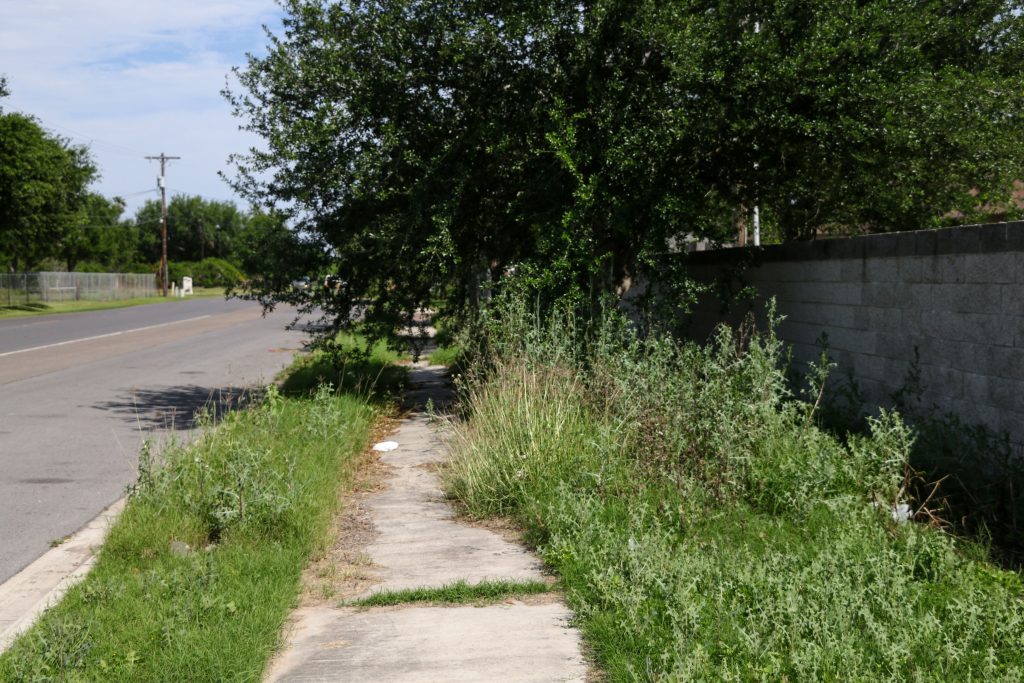
Further down Mile 4 Rd is a small neighborhood right before Taylor Road with a sidewalk. Similarly to the previous sidewalk, it ends at the property line. Some hazards here include a low-hanging tree covering the pavement with its branches, fallen leaves that fill up the walkway and high grass covering the edges and leaning over onto the path.

A sidewalk covered by low-hanging trees and tall grasses.
Photo Courtesy of Jordynn Garza.

Overgrown grass and branches are huge hazards for people and must be properly maintained. As the Americans with Disabilities Act Accessibility Guidelines states, “Objects may not hazardously protrude onto sidewalks, shared use paths, or other pedestrian circulation paths.” The overgrowth can cause the sidewalks to crack, and thick tree roots change the elevation of the concrete, increasing the chances of serious falls and injuries. 


When the streets are littered with potholes and existing sidewalks are broken, forgotten and blocked, the community living in these cities has nowhere to walk. A recent survey states that 12.4% of people in the RGV are living with disabilities. That means 175,699 out of 1,416,929 people who live in the Valley are unable to go anywhere. Attempting to navigate through these patchy and uneven areas is incredibly difficult and nearly impossible. 

Pothole Pandemonium

Every form of commute, from walking, biking, and horseback riding, shares the same two-lane pothole-filled street as the cars meant for the road. There are hardly any usable sidewalks for other commuters to travel on, and staying off the road leads them to tracts of grass that are tougher to navigate than the damaged roads. 


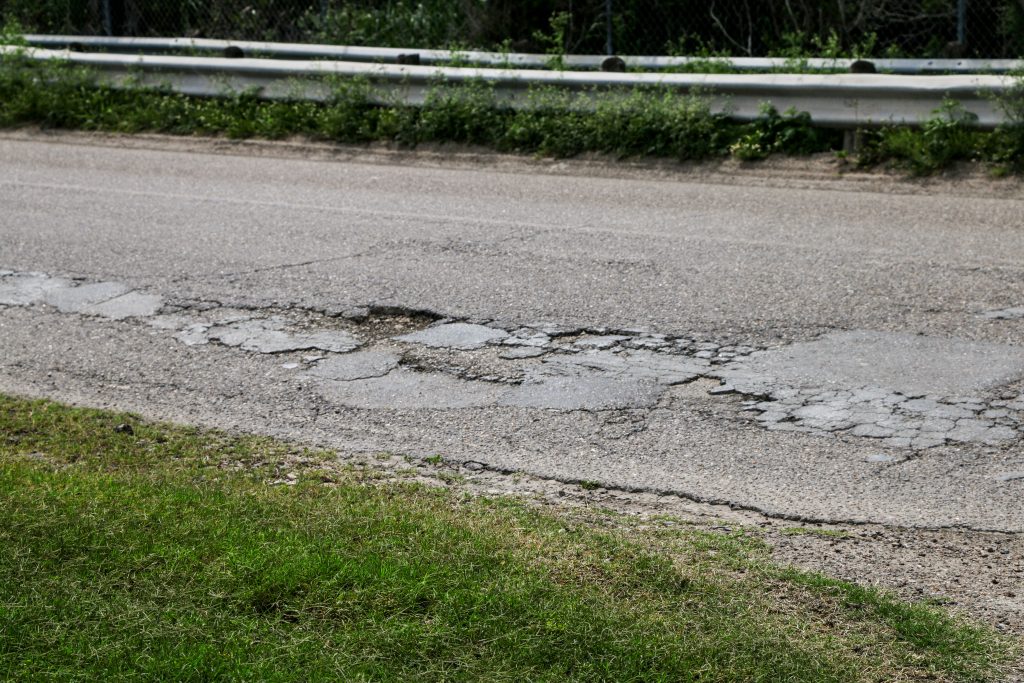
Patchworks of black and gray cover the center of the road. New potholes grow over and deepen existing ones. Palmhurst streets are worse for wear each passing day as potholes cluster up and form large spans of broken roads. The city temporarily fills the potholes, but rain and hot days wear down the filling too quickly for it to matter. While the City Council of Palmhurst is spending meeting time “proclaiming May 12 – May 18, 2024, as National Police Week,” they could spend more time addressing the urgent issue of road damage throughout Palmhurst.


We see this issue in streets such as Mile 4 Rd, which has a stretch of horrible potholes that makes commuting down the road unbearable and greatly harms the environment. Rough roads increase fuel consumption from cars traveling through, leading to higher levels of greenhouse gasses. Additionally, potholes build-up rainwater pools, impede natural drainage and magnify erosion. Erosion of our roadways results in an increase in sediments entering our waterways. Mile 4 Rd is home to a canal with potholes surrounding it, and every day it goes unfixed, more sediment enters and ruins our water quality.  

A close look at a beat-up road with a patch on the right of poorly filled and growing potholes.
Photo courtesy of Jordynn Garza.

Community Contact

If Palmhurst and Alton want to protect their entire community, including children, people with disabilities and people who have no form of commute besides walking, then the road care needs to be placed at the forefront of the City Council Meetings. Setting it aside for any longer would be a disservice to a beautiful and strong community whose lifeline walkways have been missing for too long. 

City Council Meetings are held at 4:30 p.m. at the City Hall, located at 4417 N. Shary Road, every third Tuesday of the month. The next meeting will be on June 18, 2024. These meetings are open to the public and are a great way to communicate to the City of Palmhurst that potholes and broken sidewalks are a major danger to the community. 

Alton City Commission meetings are held on the 2nd and 4th Tuesdays of every month at 7:30 pm in the Commissioners Chambers at 509 S Alton Blvd., Alton, Texas.

To report a pothole directly, send a request to the city of Palmhurst using the service request form on the city website. Using these resources, the people of Palmhurst and Alton can voice their concerns as we move toward safer roadways. 

Mira Más

A pink flyer is pictured announcing Frontera Fund’s annual Fund-A-Thon is back. The flyer shares their annual goal of $25,000.
Uncategorized

Frontera Fund Hosts Annual Fund-A-Thon to Raise Needed Abortion Funds

Frontera Fund is in the midst of its 9th Fund-A-Thon, and they are in dire need of your support. With the many attacks on abortion access and decreasing donations due to rising costs of living, it’s more important now than ever to support safe, accessible reproductive healthcare, including access to abortion. 

Gente y Cultura

“I Saw the TV Glow”: There Is Still Time

In this Cine Trucha review, Miranda Villegas shares that “I Saw the TV Glow” serves as reassurance that your story is remarkable, no matter when in your life you start living it. The glow exuding from our TV screens is uniquely personal, and it is ultimately our choice when to face it and crawl inside.

Gente y Cultura

Weaving the Patterns / Tejiendo la Tierra: A Three-Part Series

Weaving the Patterns / Tejiendo la Tierra is a collaborative three-part series presented by Unfolded: Poetry Project, ENTRE, and Trucha, in partnership with artist Diana Lizette Rodriguez of Calle Soledad Presa, that invites the community into an immersive creative process that moves across disciplines, including poetry, bookmaking, experimental film, and performance. Learn about the series of events planned out by the team of collaborators!

Support the Frontera

We rely on generous donations to publish original works each year and support artists in the Rio Grande Valley. Our community's voices are essential in shaping the history and narrative of the frontera!

Donate

Related Posts

Hoppers: The Passion of Defending the Environment

April 27, 2026

In this collaborative review from Cine Trucha, Nina Alegre and Latifah Khuffash examine Hoppers, a comedy/sci-fi animated film. They explore…

PPST Releases Self-HPV Tests to Help Bridge Healthcare Gap in the RGV

April 22, 2026

Find out how Planned Parenthood South Texas is confronting cervical cancer through education, accessible care, and self-HPV tests!

ICE Leaving Some Airports After Partial Shutdown

April 21, 2026

Immigration and Customs Enforcement (ICE) agents have finally begun leaving some U.S. airports.

View more

newsletter

This field is hidden when viewing the form

Next Steps: Sync an Email Add-On

To get the most out of your form, we suggest that you sync this form with an email add-on. To learn more about your email add-on options, visit the following page (https://www.gravityforms.com/the-8-best-email-plugins-for-wordpress-in-2020/). Important: Delete this tip before you publish the form.
Name(Required)