Nationwide 17% of adults in the United States smoke marijuana while 15% consume marijuana edibles. Some use it recreationally every other weekend, or maybe after a long shift, while the majority of Americans support legalizing marijuana in some way. Texas lawmakers however are among the minority who oppose legalization and support criminalization.
In July, Texas began enforcing a rule that places some types of THC to a schedule 1, the same category as heroin and LSD. It comes after the Texas Supreme Court allowed the Department of State Health Services to move forward with a 2021 ruling. As a result, delta-8 and delta-10 THC types are banned, save for delta-9 at 0.3% or less per dry weight, and come with the punishments of that classification. In The Rio Grande Valley the drastic change leaves not only users, but vendors in legal headaches.

The Effects of a Schedule
At the federal level, drug scheduling is handled by the Drug Enforcement Administration (DEA) in conjunction with advising from the Food and Drug Administration (FDA) and at the state level, by the DSHS in Texas. “Schedules” in drug classifications are a measurement of their acknowledged medical use, abuse potential, and how liable they are to addiction. Each schedule, 5-1, has their own legal punishments depending on their category, 1 being the highest and being deemed as no medical use.
Despite this, Texas has the Compensation Use Program (CUP). Through CUP, the Department of Public Safety (DPS) operates a secure online registry of qualified physicians who can prescribe minimal amounts of THC to patients meeting specific criteria. It becomes evident that THC does in fact have a form of medical use and brings into question as to why marijuana is the focus. It also raises the issue of how dispensaries are able to handle the changes as more than 150,000 patients are under the CUP registry as of this year. DSHS and DPS were reached out to for comments about the effects on CUP, but DSHS did not have a department that could answer and DPS has yet to respond.
Overreach, Overpay, and Opacity
For vendors, the new rules bring unclear operating fees, the cost of testing products, and questions about what to do with existing inventory. The Texas Hemp Business Council (THBC), an industry group, is challenging parts of the state’s hemp rules in court, arguing that state agencies overstepped their authority.
At the center of the case is how products are tested. According to THBC, Texas law sets the legal limit at 0.3% delta-9 THC by dry weight, but the agencies’ rules count “total” delta-9 THC, which includes the THC that THCA, a compound in raw hemp, can become when heated. THBC argues that changing the compliance standard is a decision for the Legislature, not the DSHS.
The authority of the state comes further into question as costs rise. For manufacturers, large fees of $10,000 and $5,000 annually for vendors, will be used to support testing, inspections, and enforcement of the new rules. These fees are not only exorbitant, but in the eyes of one McAllen vendor, beyond the scope of the pockets of their businesses stating that he is “running (the smoke shop) at a loss”. The state commented in its reply brief that it neither has exceeded its authority in adopting the rules nor that the arguments of vendors are with any merit.
Another argument from vendors on the issue of testing is the costs it will have on taxpayers to actually go through the process of analyzing THC and THCA products. The testing method of decarboxylation, or “decarbing”, was found in a study to be an inefficient process to measure how much THC/THCA is in a sample of weed already. The state standing on their position would not only cost taxpayers more burden that what is already needed, but may not properly solve that part of the issue. Instead of a campaign of allowing the vendors and consumers the freedom of economic liberty and minor taxation changes, it creates lawmaking in favor of questionable decisions and cloudy judgement.
The Financial and Physical Pains
In Texas, carrying weed used to be a class A or class B misdemeanor with some possible jail time and a fine. Now with the schedule 1 ruling, carrying the illegal forms of THC can land you a felony charge, a maximum of 2 years in prison for small amounts, and a $10,000 fine. Vendors could face more problems as they are left to figure out what to do with their inventory. After speaking with different smoke shop owners, multiple lamented as to the lack of transparency as to what to do with their inventories. One adding that more than 50% of their inventory would need to be pulled from shelves. A similar experience as to what the BorderReport reported on about a smoke shop owner in El Paso who had to “dispose of thousands of dollars worth of products.”
Weed had also become a source for managing pain, especially for veterans. Mitch Fuller, VFW Dept. of Texas National/State Legislative Chairman, has spoken out multiple times about the issue in Texas. Last year at the Texas House State Affairs Committee at the legislative hearing on a weed related bill from last year, he spoke out after Senator Charles Parry claimed the hemp industry as evil and said, “What does that make us? . . . Does that make us evil in the veteran community? I don’t think it does.”
He goes on to talk about the VA prescription issue of overusing drugs, mainly opioids, that result in the suicide of many veterans. With a 2025 study finding veterans in South Texas already having major issues getting access to mental health treatment, the cost of weed tinctures, oils, or flower vastly outweigh the risk of succumbing to no treatment or worse.

The Path to Ethical Consumption
Child-resistant packaging, advertising and marketing targeted towards adults, regulations on product sales and testing, and enforcement of ethical practices are among some of the readily available methods at handling weed in Texas. An outright ban adds strain to the already overpopulated prison system in the state and as State Rep. James Talarico puts it, “a gift to the cartels” and that “this is the nanny state at its worst.” Lt. Gov Dan Patrick has been the spearhead to the weed ban campaigns, and it brings into question where the frustration comes from.
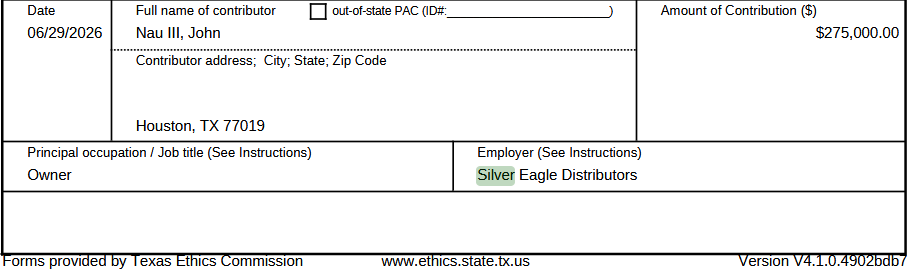
In a study from The Hobby School of Public Affairs University of Houston, their results show that 69% of Texans above the age of 21 support decriminalization of weed for personal use. The arguments do not match what the state’s constituents believe, but it possibly has the interest of alcohol groups at heart. With alcohol consumption steadily decreasing in Texas, and Lt. Gov Dan Patrick receiving contributions such as the one from Silver Eagle Distributors, an alcohol distributor out of Houston, raises the alarm as to what exactly is the purpose of the THC bans. Protecting children has been the war cry for many different topics in recent years that do not match public opinion.