Juan de Dios Mora’s art expresses a distinctly Mexican American sensibility through humor, satire, and sarcasm shaped by his lived experience and the culture of the U.S.–Mexico borderlands. I have been drawn to his work each time I have encountered it in exhibitions, most recently in “A Postmodernist Says ¿Qué?” at Centro de Artes in San Antonio. I interviewed Mora twice: first in the intimate setting of his home and studio in April 2024, and again at UT-San Antonio in July 2026. Through these conversations, I’ve had the opportunity to examine Mora’s artistic practice and its evolution over time.

Juan de Dios Mora is a multidisciplinary artist based in San Antonio. Born in Yahualica, Mexico, he moved to Laredo with his family in 1998, when he was 14. Mora studied in Laredo during his early years and attended Laredo Community College, relocating to San Antonio, where he earned his BFA and MFA from the University of Texas at San Antonio.
Over the years, Mora has exhibited nationally and internationally. Numerous institutions have acquired his work, including the McNay Art Museum in San Antonio, the University of Hawaiʻi at Hilo, the National Museum of Mexican Art in Chicago, and the Smithsonian American Art Museum in Washington, D.C., among others.
In recent years, Mora’s practice has expanded to incorporate three-dimensional shelf works that combine woodworking, metalworking, and painting. To trace the ideas and themes that have shaped that progression, I focus on his “Tremendos” series and his shelf works.
Mora’s “Tremendos” series showcases luchadores, who embody a range of personalities and archetypes. Imbued with decoration, humor, and style, they take on an avatar-like quality. Mora mixes and matches different mask colors and styles based on his emotions in the moment.
Regarding the luchadores, Mora states, “Every Sunday in Mexico, there would be wrestling matches. My family went to Mass on Sundays, and my mom didn’t like us watching the matches before church. But lucha libre is such a big part of the culture, and it has been a recurring element in my work over the years.”

Some fighters fly while others float in water, stand motionless, or race across the ground on wheels. Drawing on cars, bicycles, human anatomy, animals, pop culture, and fantasy, Mora assembles hybrid figures that feel less like individual wrestlers and more like customizable personas, each distinguished by a different luchador mask. For example, “Nor Fa” showcases a figure that’s ready to fight, with its clenched fists emerging from its ears.
The title “Nor Fa” draws inspiration from the phrase “Ni Fu Ni Fa” (neither this nor that). A goat leg extending from its hat lends the figure a devilish quality, while a rooster foot evokes bravery. A rooster foot evokes bravery and connects to Mexico’s cockfighting tradition; given Mora’s interest in fighters, the parallel is no coincidence. With these motifs, the cholo-style hat becomes a character unto itself.
Mora adds, “When I first came to the United States, Chicano culture was incredibly present. I was fascinated by magazines at gas stations that featured lowriders and people wearing stylish derby hats. You’d see cholos and pachucos. They impressed me. Chicano culture was new to me.”
The “Tremendos” figures function as guardians. Mora draws from the Catholic concept of the ángel de la guarda (guardian angel), further complicating the characters’ already hybrid identities. Equally important is the influence of rasquachismo, a working-class Chicano aesthetic rooted in resourcefulness and making the most of the least. By merging toys, wrestlers, and guardian angels into a single form, Mora found a space for experimentation that helped launch the series.
As Mora explains, “To be rasquache is to be resourceful, using ideas and everyday objects that come together in art.”

Next, “Quick as Possible” depicts a floating figure clinging to a helmet-like flying machine as it travels across a blue expanse beneath a glowing sky. Embedded references to sewing machines connect the work to Mora’s grandmother, transforming the fantastical scene into a tribute to memory and care.
As the artist explains, “My grandma used to sew and take care of me often when I was a kid while my parents worked in the fields. She encouraged me to aim high in everything I did and nurtured my imagination. For me, this piece is a way of remembering her.”
Mora’s shelf works emerged from a desire to push his practice further and create something even more personal. The “Tremendos” prints played an important role in this development. Initially, he began constructing frames for the prints, seeking ways to extend the layered character of the images into physical space. His turn toward three-dimensional work was also informed by the principles of rasquachismo.
What began as relatively simple shelves gradually evolved into expressive forms with personalities of their own. As Mora notes, “I began having fun with the process, and now I have an entire series of shelves. Making them fulfills something in my inner child. Wrestlers helped me whenever I was going through a difficult time. This is my way of honoring them.” He likens the shelves to the mascotas (mascots) of lucha libre, which are secondary characters who entertain children and support the main wrestler. Similarly, the shelves function as companions to his prints, extending and reinforcing the narratives throughout his work.
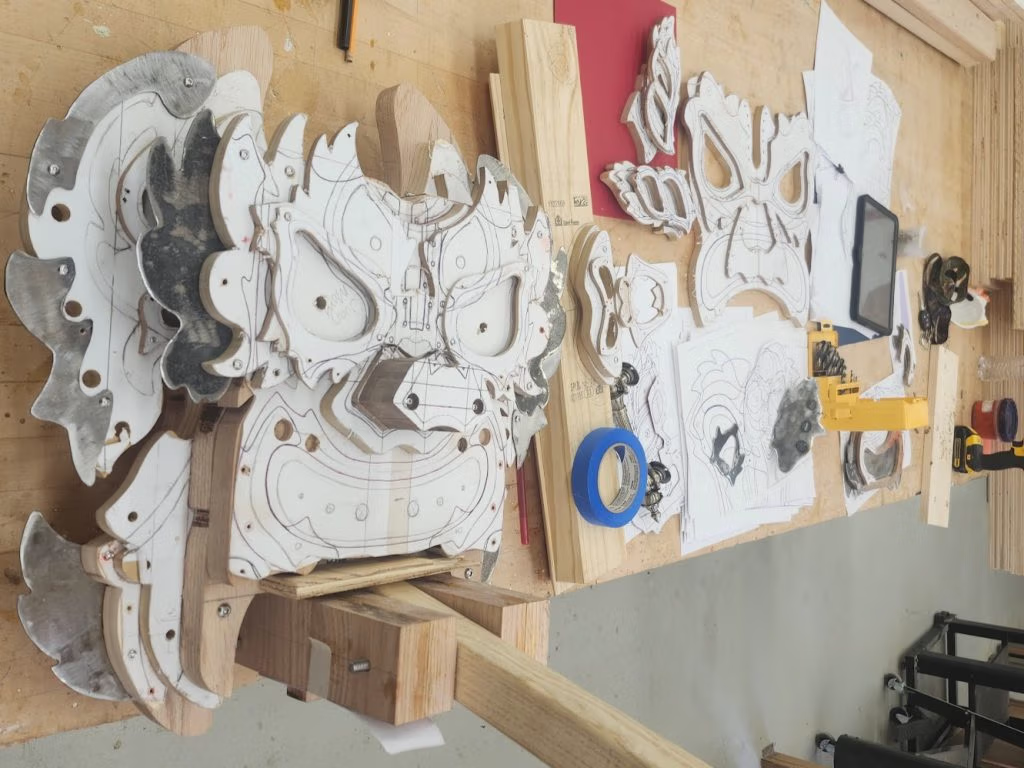
Mora works on prints and shelves in tandem while balancing his artistic practice with the demands of teaching full-time. He approaches projects in stages, and a single shelf can take anywhere from three to six months to complete.
Despite his growing investment in three-dimensional work, printmaking remains central to his practice.
One of his current projects is a tortillería press that combines additive and subtractive methods. Wooden elements are often cut, reshaped, or discarded as forms evolve, while metal components may be fabricated separately and incorporated later with the assistance of collaborators, especially his graduate students.
During my studio visit, the unfinished shelf/press was covered with pencil markings and notes. A handle purchased from China, metal pieces, and cut wood fragments awaited incorporation into the final work. Throughout the composition, however, luchador masks recur as a central motif.
As Mora explains, “For me, repetition is important to the compositions of these shelves. I use masks on them repeatedly, in different sizes, and it creates visual intrigue.”
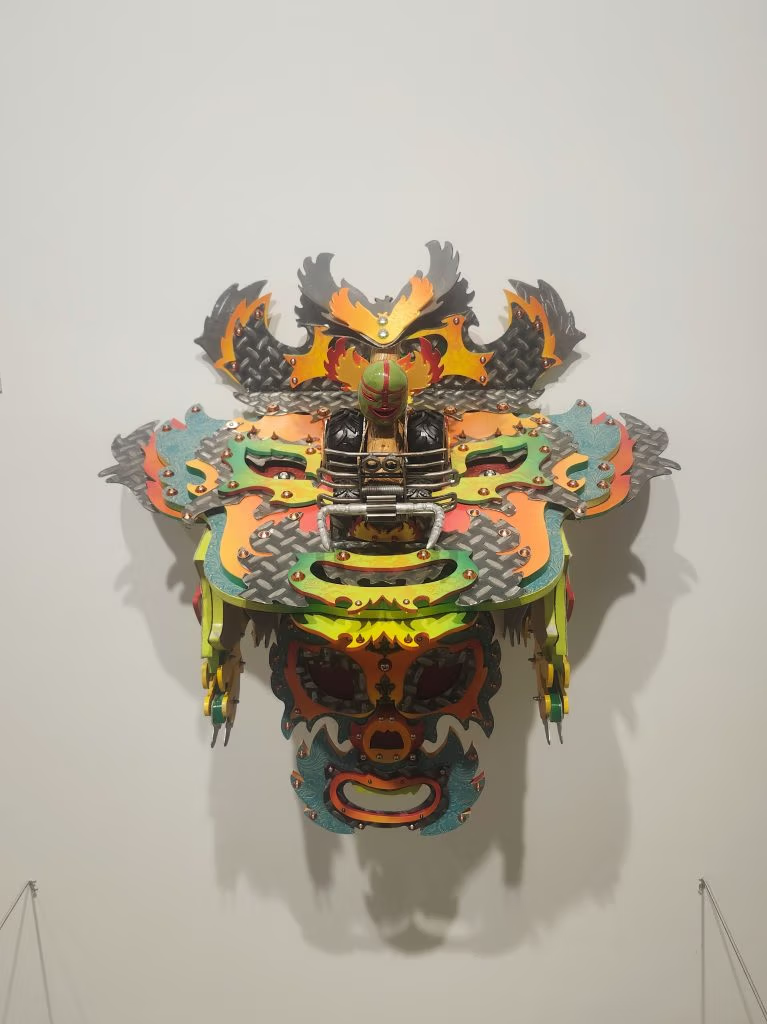
“Fido Chido” was the work on view at Centro de Artes that catalyzed this article. A towering shelf supports a tiny car, with a ceramic luchador mounted on a piece of wood riding atop it, while toy car wheels complete the assemblage. The whimsical sculpture transforms a makeshift vehicle into a dramatic stage for its luchador character, reflecting Mora’s interest in luchador imagery and the creative reuse of everyday materials. Its playfully ludicrous appearance is nevertheless deeply personal, embodying the imagination, iteration, and craftsmanship that make Mora’s work so compelling.
“Fido Chido” brings together several concepts that run throughout Mora’s practice: humor, repetition, rasquachismo, and the transformation of everyday objects into expressive avatars.