For nearly a century, lowriding culture has been embraced, questioned, and even rejected by Mexican Americans throughout the United States. This history is brought to light at the International Museum of Art & Science (IMAS) in McAllen through the traveling exhibition “Lowrider Culture in the United States.” While the show contains works that will appear at every venue on its tour, what makes the IMAS presentation unique is its focus on the history specific to the Rio Grande Valley (RGV). The Valley has often been overlooked in discussions of lowriding culture, despite its overwhelmingly Hispanic population, in favor of centering urban hubs, particularly Los Angeles.
Before examining some examples of the RGV’s lowrider scene, some historical context is valuable. In a presentation on lowriding culture, Charles M. Tatum, Professor of Spanish at the University of Arizona, explains that lowrider culture began during the 1940s and 1950s in Los Angeles (LA) by custom car enthusiasts and hot rod owners, many of whom were World War II veterans. Lowriding emerged among Mexican American youth in postwar LA as a rejection of hot rod culture’s emphasis on speed. Instead, lowriders embraced the philosophy of “low and slow,” transforming the automobile into a vehicle for creative expression, community pride, and cultural visibility.
Law enforcement frequently targeted lowriders through vehicle ordinances and traffic stops, making the customized car both a cultural statement and a symbol of resistance. These experiences paralleled broader attempts to police Mexican American and Black youth cultures during the mid-twentieth century. Furthermore, Tatum adds that by the 1960s, the invention and incorporation of hydraulics into cruiser cars, which prioritized slow riding and decoration over speed, cemented the defining characteristics of lowriders as they are known today.
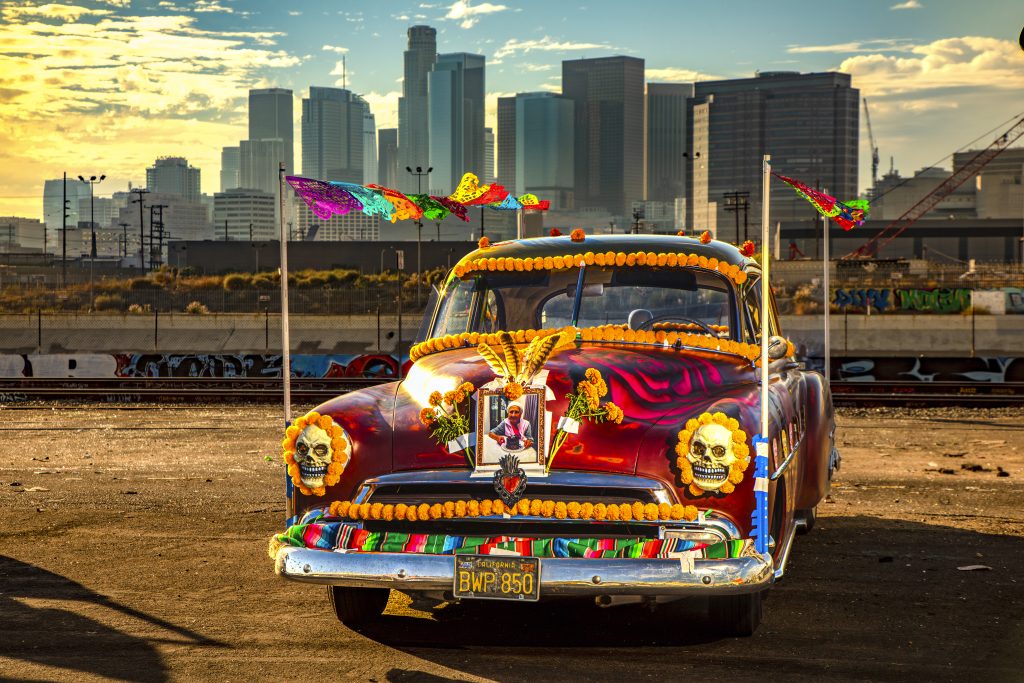
Custom paint jobs, chrome details, and highly personalized modifications define contemporary lowriders. In “Día de los Muertos,” Los Angeles-based photographer Bob Bernal Jr. presents a vintage Chevrolet decorated with marigolds, papel picado, a sacred heart, and a framed photograph of an elderly woman. Rooted in Indigenous Mesoamerican traditions and shaped by centuries of cultural exchange following the Spanish conquest, Día de los Muertos (Day of the Dead) has long served as a means of honoring deceased loved ones. I found myself asking, while looking at Bernal’s photograph: Was this woman a lowrider herself, or is she being honored by relatives keeping her memory alive?
Over 1,500 miles from LA, the Rio Grande Valley is home to its own lowrider scene, one shaped by the individuals who participate in and sustain its culture. Among them is Alamo resident Edgar Solis, photographed while pinstriping a vehicle for RGV resident Rogelio “Lolo” Loera Jr., who captured the photo. Loera’s relationship with Solis extends into his teen years. In a conversation with me, he explains, “He [Solis] did my first car when I was like 16 years old.”

The image of Solis is a still from a larger video documenting the artist’s commissioned process on one of Loera’s vehicles, a 1961 Chevy Impala. Solis began working with custom airbrushing, hand-painted pinstriping, and lettering in the ninth grade, a craft he has expanded and refined over the course of nearly four decades. His work comprises various techniques and styles, from toy lowrider cars for kids to helmets and large trucks.
Against the black hood of Loera’s vehicle, Solis’s intricate blue pinstriping creates a striking contrast. The flowing patterns transform an ordinary sheet of metal into a canvas, demonstrating the artistry that has long been central to lowrider culture. The blue embellishments may seem spontaneous, but they are organized through careful symmetry and repetition.
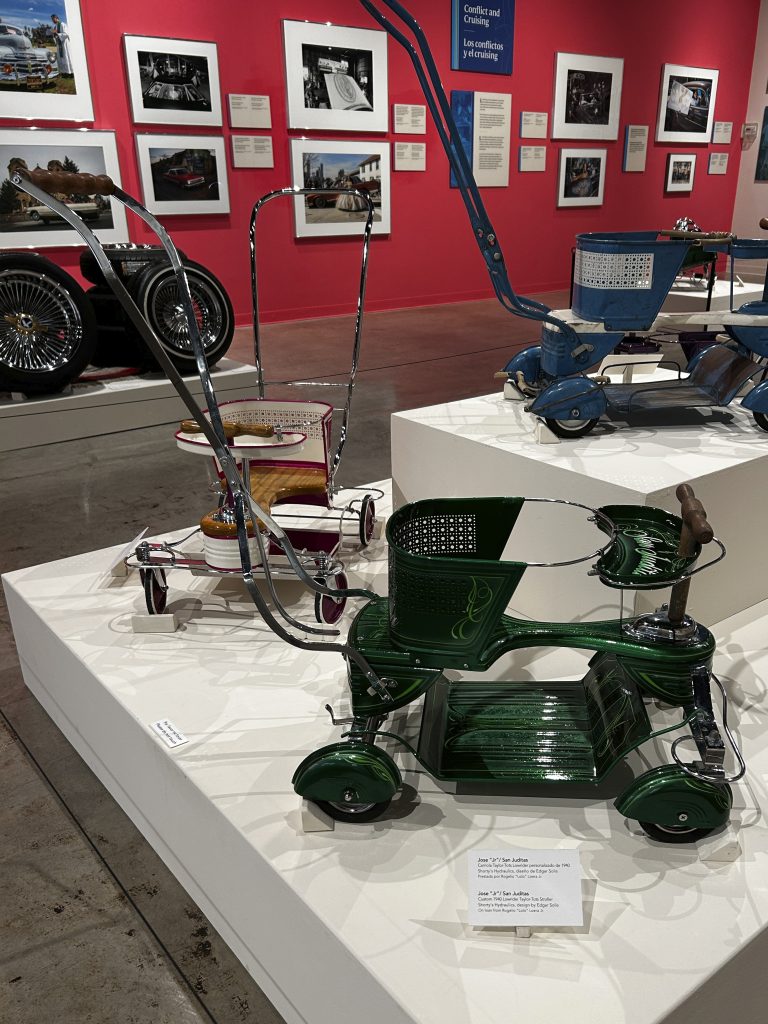
Loera Jr. is raising his own children with lowriding. On display at IMAS sits one of his toy lowrider models, Jose “Jr”/San Juditas,” a green custom 1940 lowrider Taylor-Tots stroller with yet more geometric designs by Solis; the stroller is one of several that his son uses to engage with lowriding traditions. The title, “San Juditas,” is painted in cursive onto the food tray. Loera loaned this stroller for the exhibition, and in doing so, we see how culture is transferred from one generation to the next.
Javier “Harvey” Estrada founded the RGV-based car club Latin Dreams in 1989 with several friends. Their rides included trips along the Old 83 Expressway to North 10th Street in McAllen on Saturdays; cruises finish at Westside Park and Field on Sundays. Estrada’s car club plaque spells “Latin Dreams” in a bold, tall font with a concave curve. The words “Rio Grande Valley” underneath root the club proudly in the Valley.
In a larger sense, car club plaques are badges of honor, embodying a car club’s spirit and members who work to keep Chicano culture alive, wherever a club exists, whether in the United States or abroad. Lowriders traditionally display their car club plaques in the rear window, positioned on the rear deck right behind the back seat. Regarding lowriding, Estrada states, “People always say we’re this or that, but we’re anti-gang. Respect our culture and who we are. You have a car, you build it, and it becomes your pride and your ride. We teach the youth about our culture and that’s how we keep it going.”

Latin Dreams not only cruises but maintains a strong community-based philosophy as members of the RGV Lowrider Council, which was established in 2006. Furthermore, they hosts an annual Trunk O’ Treat Event at Westside Park since 2017 and also host an Easter egg hunt open to Valley residents. Estrada explains further, “The motto of the RGV Lowrider Council is, ‘unity is everything.’ That unity is what keeps us going. The lowrider community in the Valley is like one big family. We’ve all seen our kids grow up and now my generation is passing it down. My kids are taking over the Latin Dreams car club, but I still go out and ride with them.”
This article has only touched on a few aspects of lowrider history and culture, and on the contributions of Valley figures Edgar Solis, Rogelio “Lolo” Loera Jr., and Javier “Harvey” Estrada. While lowriding originated in Southern California, the car culture has long been adapted by local communities throughout the Southwest. A photograph by Noe Barrera of cars lined up outside a Stripes convenience store in Edinburg illustrates this regional character in the Rio Grande Valley. The Texas-based chain is a familiar presence throughout South Texas. Barrera’s photo demonstrates how lowriding is embedded in everyday Valley life.
The RGV’s lowrider scene is far broader than any single article can capture. However, IMAS’s “Lowrider Culture in the United States” offers an opportunity to ensure the Valley’s place in lowriding history is recognized and celebrated.
“Lowrider Culture in the United States” is on display at the International Museum of Art & Science in McAllen through November 15, 2026.