The Texas Commission on the Arts (TCA) voted on the approval of the state’s new Cultural Districts, including Edinburg and Brownsville. They will join the City of McAllen as the RGV’s latest communities to earn the state designation, called the Edinburg Cultural District and the Mitte Cultural District, respectively. In addition to funding access for local organizations, the designation provides an entry point for a larger conversation about creative and cultural equity locally and statewide.
This two-part series will first discuss the new RGV Cultural Districts, the statewide resources they provide and how RGV arts organizations have and are poised to benefit from them in 2027.
Public-Private Partnership
Cultural Districts are zones “that harness the power of cultural resources to stimulate economic development and community vitality.” According to the TCA, these districts can “become focal points for generating businesses, attracting tourists, stimulating cultural development and fostering civic pride.”
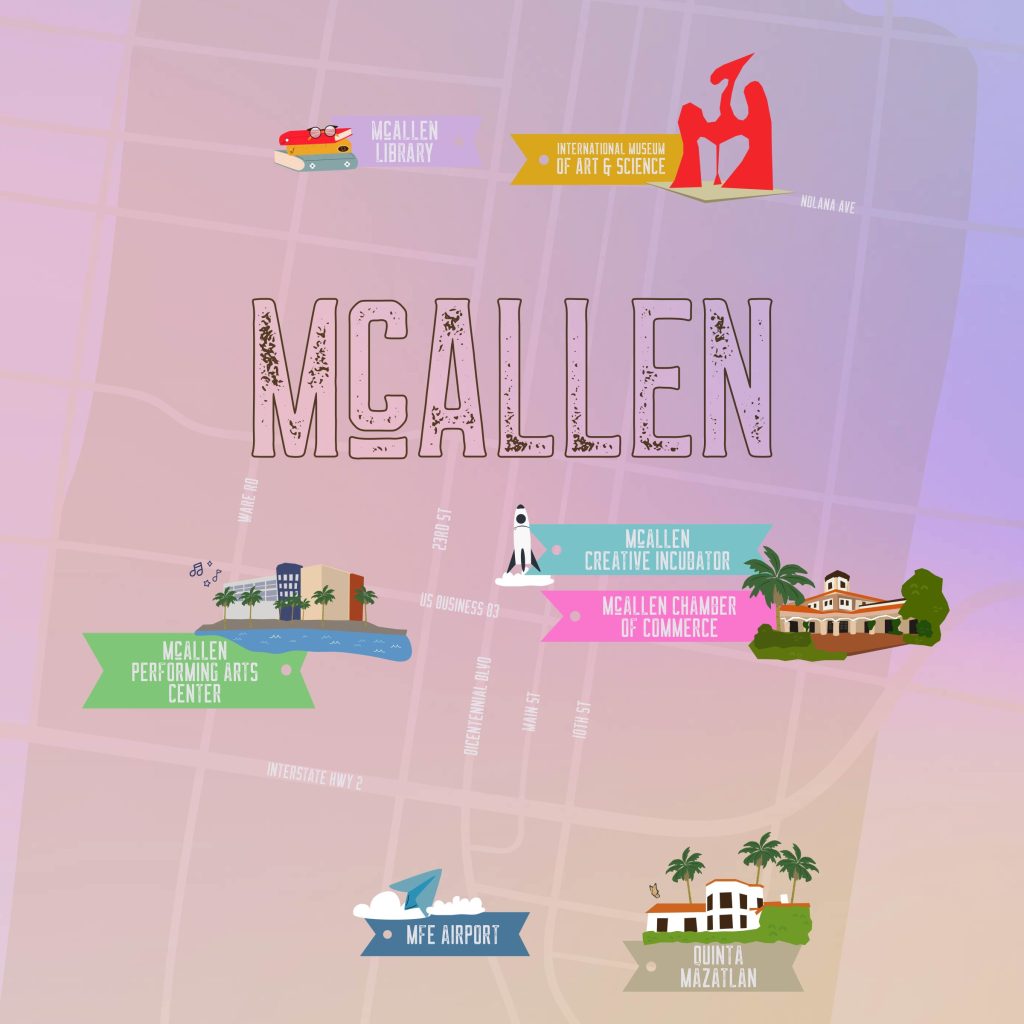
The McAllen Cultural District was the first in the RGV to be designated by the TCA in 2009 as part of the statewide Cultural District program pilot. The McAllen Cultural District boundaries were extended in 2018 to North Dove Ave, South Sunset Drive, East 2nd Street to West Ware Rd. It includes a large portion of the City of McAllen, including many of its cultural landmarks, such as the McAllen Performing Arts Center, the International Museum of Arts and Science (IMAS), the Main Street Arts District, Quinta Mazatlan, and the McAllen Public Library.
Dr. Gary Gibbs, Director of the TCA, mentions that since the pilot, the TCA now promotes more walkable districts. The newly approved Edinburg Cultural District, in comparison, is more compact, covering Schunior Street on the north, Stubbs Street on the south, Sugar Road on the west, and 19th Street on the east. It will encompass the new Edinburg Arts and Culture Education Center (ACE), the Museum of South Texas History and parts of the University of Texas Rio Grande Valley.
“Receiving the state designation for our Cultural District is a testament to what happens when an entire city rallies around creativity, heritage, and civic pride,” wrote Letty Lejia, the Edinburg Library and Cultural Arts Director. “Hand in hand, we are building a walkable, vibrant corridor that honors our roots while inspiring our future.”
In Cameron County, the Mitte Cultural District covers the “historic downtown core and Dean Porter Park Area” in Brownsville, Texas. Its boundaries extend from Palm Boulevard to Sixth Street and south to International Boulevard and the Gateway International Bridge. According to the TCA map, it is “home to more than twenty collaborating arts and cultural organizations.” Some include Brownsville’s Children’s Museum, the Mitte Cultural Center (previously the Brownsville Museum of Fine Arts), the Brownsville Performing Arts Center, the Brownsville Heritage Museum, the Revival of Cultural Arts at the Carlotta K. Petrina Cultural Center, and the Flowershop Gallery.
Arts Respond & More Creative Resources
In addition to the “cultural cohesion” of a region, a major benefit of Cultural District designations is the state funding that vetted 501-C3 arts organizations can access. This includes access to the Arts Respond Cultural District Projects in addition to the general Arts Respond Projects.
The Arts Respond Cultural District Projects (ARCDP) funds are specifically for cultural districts. Funding supports district management and operations, marketing, major arts/cultural programming, signage, beautification projects, and capital improvements.
In 2024, IMAS received a Cultural District Project Grant of $74,954 for a marketing campaign to increase visitors to the museum and the McAllen Cultural District. In 2026, the TCA awarded Cultural District Projects to the City of McAllen/Performing Arts Center ($189,796) for the multi-day arts festival MXLAN, and ToGive International ($39,321) to “support the McAllen Creative Incubator.”
The Art Responds Projects (ARP) are competitive short-term, project-specific grants that address the following priority areas: Education, Health and Human Services, Economic Development, Safety and Criminal Justice, and Natural Resources and Agriculture.
In the RGV, organizations like the Brownsville Performing Arts Center, the Valley Symphony Orchestra, and the IMAS have previously received funding, respectively, for the Brownsville Guitar Festival, for exhibitions including “Insecta: Small Wonders of the World,” and for the 2nd annual Spring Strings chamber concert held at the Gelman Stained Glass Museum.
Another TCA program benefiting RGV arts organizations is the Arts Creates grant, which invests in eligible arts organizations to advance “the creative economy of Texas” through matching multi-year operational support.
Future State Funding
So far, the TCA has approved $89,260 in state funding directly to RGV arts organizations for Fiscal Year 2027, which started this September. The ARP program awarded $9,000 to IMAS, $7,000 to the South Texas Symphony Association, $5,500 to the Brownsville Society for the Performing Arts, and $4,000 to ToGive International for a total of $25,500. The funds support programs including exhibitions, a guitar festival, educational orchestra concerts and fine arts classes for K-12th grade students.
The total Arts Creates grants awarded in the RGV for 2027 were $59,000, of which the South Texas Symphony Association received $12,000, the City of McAllen/Performing Arts Center received $15,000, IMAS received $16,000 and ToGive International received $16,000. These organizations are all in their second year of the two-year operational support grant.
Other funding approved by the TCA for RGV arts and culture includes Artistic Fee subsidies for a theatre performance at the University of Texas Rio Grande Valley Performing Arts Center ($1,935) and for a ballet performance for the South Texas Music and Cultural Arts Foundation ($2,400). Mission ISD was awarded $425 for a performance at Mission Junior High
Outside organizations also received AR funding for programs that benefit RGV locals. Laboratorio Arts from Austin was funded $6,500 for multimedia concerts for audiences throughout the state, including Brownsville. The University of Houston’s Arte Publico Press received $3,500 for author presentations in RGV schools (UH has an RGV office). If these awards are included, the current total TCA funding for RGV arts and culture programming for 2027 amounts to $99,250.
What to Expect?
As we have seen in McAllen, established local institutions like museums, youth-focused arts organizations, even the City and the Performing Arts Center have primarily benefited from TCA’s operational and programmatic grants. Ultimately, the RGV communities these institutions serve reap the benefits of their continued programming. The new RGV Cultural District designations are bound to bring more opportunity for eligible organizations to access statewide funding. Smaller eligible nonprofits are encouraged to take advantage of the grants available by the Texas Commission on the Arts.
Whether the cultural designation can lead to a cohesive cultural strategy, and what that can look like, is a conversation to be explored in the next segment.